
If you just had a new AC or heat pump system installed and it started acting up right after a Nest thermostat update, reboot, or reconnection, you're not imagining it. One of the more frustrating failure patterns we see on brand-new Carrier installs is a heat pump that blows cold air on a heat call, short-cycles, or trips its low-voltage fuse — and the thermostat is the actual root cause, not the new equipment.
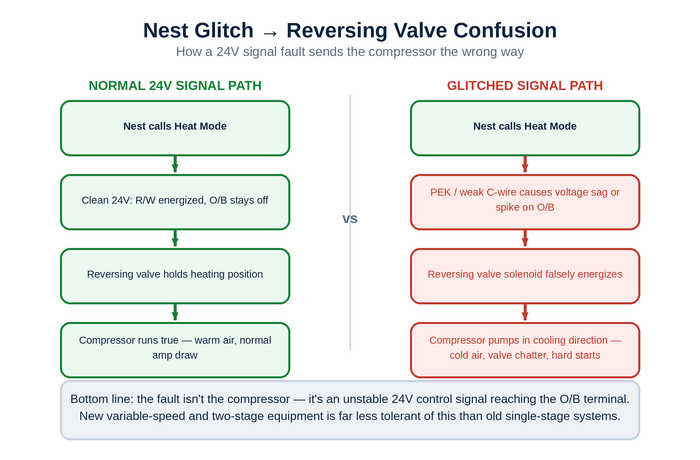
The mechanism is electrical, not mechanical: a glitching Nest can destabilize the 24-volt control signal that tells your compressor's reversing valve which direction to run. When that signal misfires, the valve can energize incorrectly and put the compressor into the wrong mode relative to what the thermostat display says it's doing.
What "Reversing the Compressor" Actually Means
On a heat pump, one component decides whether the system heats or cools: the reversing valve. It's a solenoid-controlled valve that flips refrigerant flow direction through the coils. Which way it sits is controlled entirely by a low-voltage signal, usually on the O or B terminal, running at 24 volts from the thermostat's transformer.
The compressor itself doesn't know "heat" from "cool." It just pumps refrigerant. The reversing valve is what determines which coil becomes the condenser and which becomes the evaporator. So when people say a glitch "put the compressor in reverse," what's actually happening is the reversing valve is being told to sit in the wrong position — cooling the house when the thermostat is calling for heat, or vice versa.
Why Nest Thermostats Are Especially Prone to This
This isn't a knock on Nest as a product — it's a wiring reality specific to how Nest powers itself. A few root causes show up over and over on service calls:
- No dedicated C-wire. Nest is designed to run on a common wire, but many older homes don't have one pulled to the thermostat. Nest compensates by borrowing tiny amounts of power from other terminals to keep its screen alive.
- Power Extender Kit (PEK) instability. Nest's workaround for a missing C-wire is the PEK, which shares the 24V circuit in a way that can cause voltage sag or brief spikes on the O/B line — exactly the terminal that drives the reversing valve.
- Firmware updates and reboots. A mid-cycle Nest reboot can momentarily drop or re-energize O/B output unpredictably, especially if the thermostat is already power-starved.
- Compatibility gaps with 2-stage/variable-speed control boards. Not every Nest model or wiring configuration is fully validated against multi-stage heat pump logic, and a mismatch can cause the thermostat to send signals the new control board interprets incorrectly.
The Symptoms Homeowners Actually Notice
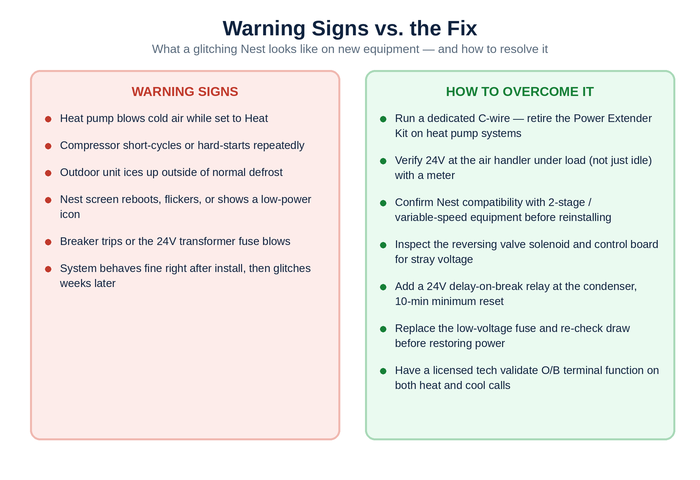
Most people don't diagnose this as a wiring issue — they just notice the system "isn't working right" after a new install or a thermostat swap. The pattern usually looks like one or more of the following:
The Risk to New Equipment
A one-time glitch that self-corrects is annoying but usually harmless. The real risk is repeated exposure:
- Compressor stress. Repeated false reversing-valve calls force the compressor to work against pressure it wasn't designed to handle in that moment, which shortens its life and can trigger a hard lockout.
- Blown low-voltage fuse or transformer damage. A shorted or unstable 24V circuit is one of the most common causes of a blown control-board fuse on a brand-new install.
- Warranty complications. Manufacturer compressor warranties can be denied if the failure is traced to an aftermarket low-voltage control issue rather than a defect in the equipment itself — which is exactly why catching this early matters.
How to Overcome It — the Permanent Fix
- Run a real C-wire. This solves the root cause instead of managing around it. On most Spring-area homes this is a straightforward pull through the existing thermostat wire run or attic access, and it eliminates the PEK entirely.
- Retire the Power Extender Kit on heat pump systems. PEKs were never intended as a permanent solution on equipment with a reversing valve. If a C-wire isn't feasible, a dedicated 24V transformer tap is a more stable alternative than a PEK.
- Load-test the 24V circuit. A voltage reading that looks fine at idle can still sag under load when the reversing valve solenoid actually pulls current. A tech should check this with the system running, not just at rest.
- Confirm thermostat-to-equipment compatibility. Two-stage and variable-speed Carrier systems need to be matched against Nest's supported wiring configurations for that specific control board — this is a five-minute check that prevents a lot of callbacks.
- Inspect the reversing valve solenoid and board for stray voltage. If the glitch has already happened more than once, the solenoid and control board deserve a direct inspection, not just a wiring fix.
- Replace the low-voltage fuse and re-verify draw before putting the system back in full service, especially if a fuse has already blown once.
- Install a 24V time-delay relay at the condenser. Wiring a delay-on-break relay into the low-voltage circuit at the outdoor unit holds the compressor off for a minimum 10-minute reset window any time power is interrupted or the thermostat signal drops out. This keeps a momentary Nest glitch from immediately re-firing the compressor before the thermostat and control board have had time to fully recharge and re-sync, which is what actually causes the repeated short-cycling and hard starts.
FAQ
Is this a Nest problem or an HVAC problem?
Both, in a sense — it's a mismatch between how Nest powers itself without a proper C-wire and how sensitive modern reversing-valve control is to a noisy 24V signal. The fix touches both sides: correct the low-voltage wiring, and confirm the thermostat is configured correctly for the specific equipment.
Can I just switch back to my old thermostat?
That will usually stop the symptom, but it doesn't fix the underlying wiring gap, and it gives up the features you bought the Nest for. Running a proper C-wire lets you keep the smart thermostat without the instability.
Did this damage my new compressor?
Not necessarily — a brief reversing-valve glitch is common and often harmless. But repeated cycling through it, a blown fuse, or unusual sounds from the outdoor unit are reasons to have it inspected before you keep running the system.
Will this void my equipment warranty?
It can, if a failure is traced to an unresolved low-voltage wiring issue rather than an equipment defect. Getting the C-wire and signal verified after install protects both the equipment and the warranty.
Get Your 24V Control Wiring Verified
If your new AC or heat pump is doing anything on this list, we'll load-test the low-voltage circuit, correct the C-wire setup, and confirm your Nest is configured correctly for your specific equipment — Spring, Woodlands, Conroe, Cypress, Tomball, and Houston.
Schedule a Diagnostic