
AC Refrigerant Leak Detection: Methods, Signs & Repair
A refrigerant leak means the sealed circuit has a physical opening allowing refrigerant to escape. Technicians use electronic detectors, UV dye, soap bubble tests, and nitrogen pressure tests to locate leaks, often combining more than one method.
"Just add a pound of freon" is not a repair. Topping off refrigerant without finding and fixing the leak means the same problem returns, usually within months.
Texas HVAC License TACLB43277C.
What This Guide Covers
Signs of a Refrigerant Leak
Weak or Warm Cooling
Reduced refrigerant mass flow lowers system capacity.
Hissing or Bubbling Sound
Active leaks at a joint or valve can be audible up close.
Ice on the Evaporator or Lines
Low charge can drop suction pressure low enough to freeze the coil.
Oily Residue at Fittings
Refrigerant oil often leaves a visible trace at the leak point.
Rising Electric Bills
A struggling, undercharged system runs longer to keep up.
Repeated Low-Charge Diagnoses
Needing a "top off" more than once points to an unrepaired leak.
How Technicians Find a Refrigerant Leak
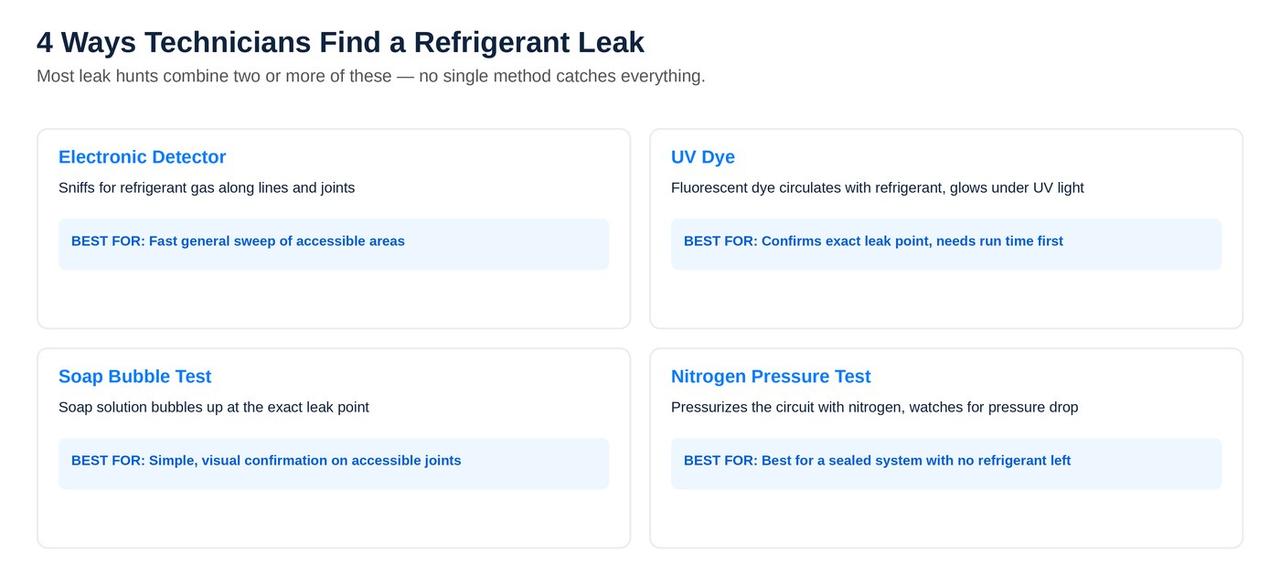
Most thorough leak searches combine more than one of these methods, since each has strengths in different situations. An electronic sniffer covers ground quickly, UV dye confirms an exact point after the system has run with dye circulating, a soap bubble test gives a simple visual confirmation, and a nitrogen pressure test works even when there's no refrigerant left to detect.
Where AC Systems Actually Leak
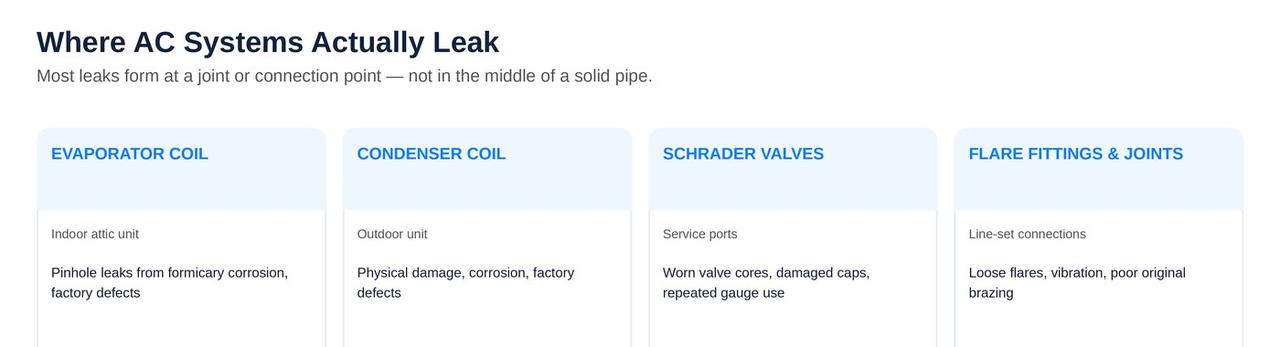
Most leaks form at a connection point rather than in the middle of solid tubing. Evaporator coils are especially vulnerable to a slow, pinhole-style corrosion called formicary corrosion, which can be difficult to find without dye or a careful electronic sweep.
The Leak Detection Process
- Review symptoms and service history
- Inspect visible components for oil residue
- Sweep accessible joints and valves with an electronic detector
- Add UV dye if not already present and allow it to circulate
- Inspect under UV light on a follow-up visit if needed
- Use a soap bubble test on suspect fittings
- Pressure test with nitrogen if the system has little or no refrigerant left
- Document the confirmed leak location before repair
How Refrigerant Leaks Are Repaired
- Repair or replace a leaking flare fitting or joint
- Braze a leaking line-set connection
- Replace a leaking evaporator or condenser coil
- Replace a worn Schrader valve core
- Evacuate the system to remove air and moisture
- Recharge to the manufacturer-specified weight
Repair or Replace?
Most leaks at joints, valves, and fittings are repairable. A leaking evaporator or condenser coil is a larger repair, and replacement becomes more relevant on an older system, especially one already out of warranty or using an outdated refrigerant.
Suspect a Refrigerant Leak in Spring or The Woodlands?
AC Repair Expo Heating & Cooling Inc provides refrigerant leak detection and repair throughout Spring, The Woodlands, Tomball, Cypress, Conroe, Humble, Kingwood, and nearby North Houston.
- Electronic leak detection
- UV dye leak tracing
- Nitrogen pressure testing
- Coil and fitting repair
- Proper evacuation and recharge
Frequently Asked Questions
How do technicians find refrigerant leaks?
Common methods include electronic detectors, UV dye, soap bubble tests, and nitrogen pressure testing, often combined.
Can I just add more refrigerant instead of finding the leak?
Topping off without repairing the leak is a temporary fix. The refrigerant will leak out again.
Where do AC systems usually leak?
Common points include evaporator and condenser coils, Schrader valves, and flare fittings or joints in the line set.
What is formicary corrosion?
It's a pattern of tiny pinhole leaks in copper coil tubing caused by certain airborne chemicals, common in evaporator coils.
Does low refrigerant always mean a leak?
Not necessarily, but persistent low charge or repeated top-offs strongly suggest one.
Is UV dye safe for my AC system?
Yes, when the correct type and amount are used for the system's refrigerant.
How long does a leak search take?
It depends on the system and leak size — some are found quickly, others require dye and a follow-up visit.
Can a leak be repaired without replacing the coil?
Often yes, if the leak is at a joint or valve rather than inside the coil itself.
Is it illegal to vent refrigerant?
Yes. Refrigerant must be recovered with approved equipment, not released into the atmosphere.
How much does leak repair cost?
Cost varies widely by leak location, from a simple fitting repair to a full coil replacement.
Can a leak get worse over time?
Yes. Vibration, corrosion, and thermal cycling can turn a small leak into a larger one.
When should I call an HVAC technician?
Call when cooling is weak, you hear hissing near the unit, or you've needed refrigerant added more than once.