
AC Overcharged With Refrigerant: Symptoms, Diagnosis & Repair
An overcharged AC has more refrigerant than the system is designed to hold. Too much refrigerant can raise head pressure, increase subcooling, elevate compressor amperage, reduce cooling efficiency, and create floodback risk.
Overcharge is often confused with dirty condenser coils, failed condenser fans, airflow problems, metering-device faults, or incorrect testing conditions. Proper diagnosis requires more than one pressure reading.
Licensed Texas HVAC contractor TACLB43277C. Serving Spring, The Woodlands, Tomball, Cypress, Conroe, Humble, Kingwood, and nearby North Houston communities.
What This Guide Covers
What Does Refrigerant Overcharge Mean?
Every AC system is designed for a specific refrigerant charge based on coil volume, line-set length, metering device, and manufacturer requirements.
Overcharge can happen when:
- Refrigerant is added without verifying the existing charge
- Charge is adjusted from pressure alone
- Airflow problems are mistaken for low refrigerant
- Long-line adjustments are calculated incorrectly
- Recovered refrigerant is added back without accurate weighing
- A previous restriction was misdiagnosed as low charge
More Refrigerant Does Not Mean More Cooling
An overcharged system can lose capacity and efficiency while placing additional stress on the compressor.
10 Common Symptoms of an Overcharged AC
1. High Head Pressure
Excess liquid refrigerant occupies condenser volume and raises condensing pressure.
2. High Subcooling
Too much liquid refrigerant remains in the condenser and liquid line.
3. Elevated Compressor Amps
The compressor works against higher pressure and may draw more current.
4. Poor Cooling
System capacity can fall even though pressures appear high.
5. Long Run Times
The system may run longer to satisfy the thermostat.
6. Hot Compressor
Higher compression load and poor operating conditions increase temperature.
7. Low Superheat
Some overcharged systems may feed the evaporator too heavily.
8. Floodback Risk
Liquid refrigerant may return toward the compressor.
9. High Discharge Temperature or Pressure Stress
The compressor and discharge components operate under greater load.
10. Nuisance High-Pressure Trips
Protection controls may open during hot weather or poor condenser airflow.
Why Overcharge Raises Head Pressure
The condenser must reject heat and convert high-pressure vapor into liquid. Too much refrigerant can fill more of the condenser with liquid, reducing the area available for condensing.
Head pressure can rise further when combined with:
- Dirty condenser coil
- Weak condenser fan
- High outdoor temperature
- Air recirculation around the condenser
- Non-condensable gases in the system
Why High Subcooling Matters
Subcooling measures how far liquid refrigerant temperature is below its saturation temperature.
On many TXV systems, excessive subcooling can indicate too much liquid refrigerant stored in the condenser.
However, high subcooling can also result from:
- Liquid-line restriction
- Restricted filter-drier
- Underfeeding TXV
- Low indoor load
- Incorrect measurement conditions
That is why subcooling must be interpreted with superheat, airflow, pressure, temperature, and manufacturer targets.
How Overcharge Stresses the Compressor
- Higher condensing pressure
- Higher compression ratio
- Elevated running amperage
- Increased motor temperature
- Potential oil dilution
- Reduced operating efficiency
- Higher risk of overload or pressure-control trips
Hot Texas Weather Makes It Worse
High outdoor temperature already raises condensing pressure. Overcharge adds even more load during peak summer conditions.
Can Overcharge Cause Floodback?
Yes. In some conditions, excess refrigerant can contribute to low superheat and liquid refrigerant returning through the suction line.
Floodback can cause:
- Oil dilution
- Compressor noise
- Bearing wear
- Valve damage
- Foaming oil
- Reduced lubrication
Low superheat must be evaluated carefully because airflow, TXV behavior, load, and sensor placement also affect it.
Problems That Can Mimic Refrigerant Overcharge
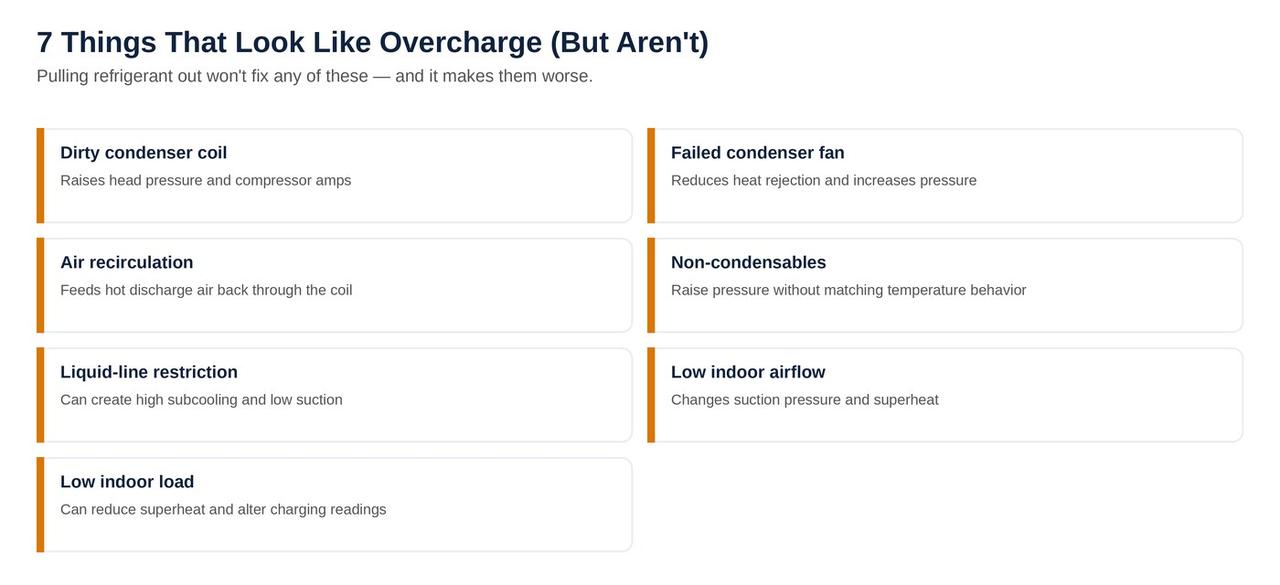
| Condition | Why it looks similar |
|---|---|
| Dirty condenser coil | Raises head pressure and compressor amps |
| Failed condenser fan | Reduces heat rejection and increases pressure |
| Air recirculation | Feeds hot discharge air back through the coil |
| Non-condensables | Raise pressure without matching expected temperature behavior |
| Liquid-line restriction | Can create high subcooling and low suction |
| Low indoor airflow | Changes suction pressure and superheat |
| Low indoor load | Can reduce superheat and alter charging readings |
Overcharge vs. Refrigerant Restriction
| Clue | Overcharge | Restriction |
|---|---|---|
| Head pressure | Often high | May be normal or vary by restriction location |
| Subcooling | Often high | Often normal or high |
| Superheat | May be low or normal | Often high |
| Temperature drop at component | Usually absent | Often present |
| Compressor amps | Often elevated | May be elevated or normal depending on condition |
Overcharge vs. Dirty Condenser Coil
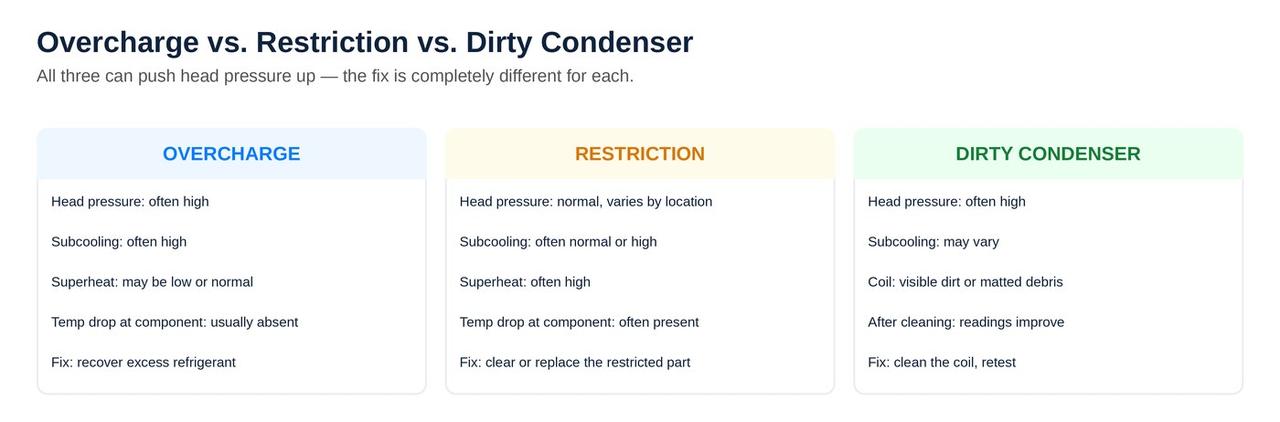
| Clue | Overcharge | Dirty condenser coil |
|---|---|---|
| Coil condition | May be clean | Visible dirt, matted debris, or restricted fins |
| Subcooling | Often high | May vary |
| Head pressure | Often high | Often high |
| After coil cleaning | Readings remain abnormal | Readings improve |
| Charge by weight | Above manufacturer requirement | May be correct |
How a Technician Diagnoses Refrigerant Overcharge
- Verify indoor airflow and filter condition
- Inspect evaporator and condenser coils
- Verify condenser fan operation
- Identify refrigerant type
- Measure suction and liquid pressures
- Calculate superheat and subcooling
- Measure compressor amperage
- Check line temperatures
- Compare readings with manufacturer targets
- Review line-set length and charge adjustment
- Recover and weigh refrigerant when needed
- Confirm performance after correction
Charge Must Be Checked Under Correct Conditions
Outdoor temperature, indoor load, airflow, and equipment stabilization all affect charging measurements.
How Refrigerant Overcharge Is Corrected
The correct repair is to remove excess refrigerant using approved recovery equipment and return the system to the manufacturer-required charge.
The process may include:
- Recover refrigerant into an approved cylinder
- Verify charge by weight
- Recheck superheat and subcooling
- Confirm compressor amperage
- Check condenser airflow
- Verify full system performance
Can Overcharge Damage the AC?
Yes. Continued operation can contribute to:
- Compressor overheating
- High-pressure shutdowns
- Motor overload
- Floodback and oil dilution
- Reduced cooling efficiency
- Shorter compressor life
Does Overcharge Mean You Need a New AC?
Usually not. Overcharge is typically corrected by recovering the excess refrigerant and verifying the system is otherwise healthy.
Replacement becomes more relevant when overcharge has contributed to compressor damage, the system is old and out of warranty, or multiple major components are failing.
Suspect an Overcharged AC in Spring or The Woodlands?
AC Repair Expo Heating & Cooling Inc provides refrigerant-charge diagnostics throughout Spring, The Woodlands, Tomball, Cypress, Conroe, Humble, Kingwood, and nearby North Houston.
Our licensed technicians check airflow, condenser condition, fan performance, pressures, superheat, subcooling, compressor amperage, refrigerant type, and manufacturer charge requirements before removing or adding refrigerant.
Texas HVAC License TACLB43277C- Superheat and subcooling testing
- Compressor amperage checks
- Condenser airflow diagnosis
- Refrigerant recovery and weighing
- Manufacturer charge verification
- Clear repair recommendations
Frequently Asked Questions
What are the symptoms of an overcharged AC?
Common symptoms include high head pressure, high subcooling, elevated compressor amps, poor cooling, long run times, and possible low superheat or floodback.
Can too much refrigerant reduce cooling?
Yes. Overcharge can reduce condenser capacity and overall system efficiency.
Can an overcharged AC trip on high pressure?
Yes. High condensing pressure may open a pressure switch or overload protection.
Does high head pressure always mean overcharge?
No. Dirty coils, failed condenser fans, air recirculation, and non-condensables can also raise head pressure.
Does high subcooling always mean overcharge?
No. Restrictions, low load, and incorrect test conditions can also produce high subcooling.
Can overcharge cause low superheat?
Yes. Excess refrigerant can contribute to overfeeding and floodback in some conditions.
Can overcharge damage the compressor?
Yes. It can increase pressure, amperage, temperature, and floodback risk.
How do technicians confirm overcharge?
They verify airflow, coil condition, pressures, superheat, subcooling, amperage, and charge by weight when needed.
Can I release refrigerant myself?
No. Refrigerant must be recovered with approved equipment by a qualified technician.
Can a dirty condenser look like overcharge?
Yes. Both can create high head pressure and elevated compressor amps.
How is overcharge fixed?
Excess refrigerant is recovered and the system is adjusted to the manufacturer-required charge.
When should I call an HVAC technician?
Call when the system has high-pressure trips, poor cooling, unusually high amperage, or a recent refrigerant adjustment that made performance worse.