
Why AC Capacitors Fail in Texas Heat
Every AC run capacitor loses capacitance over time — that part is unavoidable. What Texas summers do is compress a 12-year timeline into 6 or 7. Heat accelerates the internal chemical breakdown that eventually drops a capacitor below its rated value.
It's one of the most common — and most affordable — AC repairs, but knowing why it happens helps you catch it before it strands you on a 100°F afternoon.
Texas HVAC License TACLB43277C.
What This Guide Covers
How Heat Accelerates Capacitor Failure
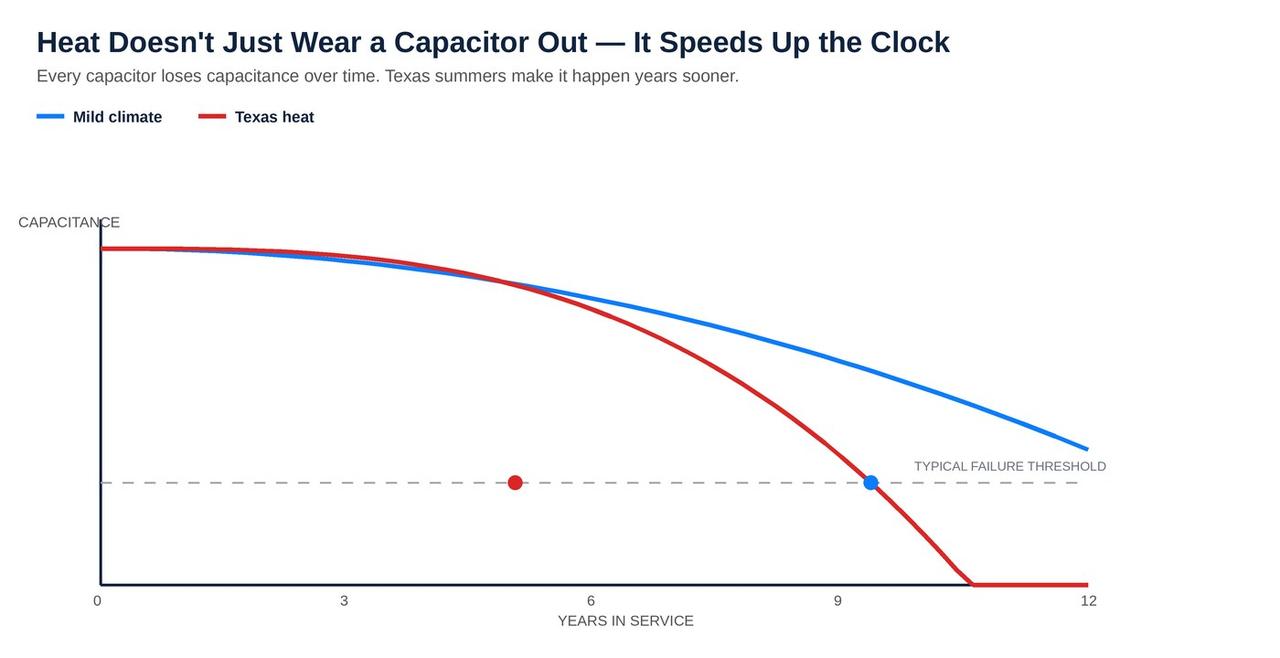
Inside a run capacitor, an electrolyte and dielectric film gradually break down every time the unit operates — that's a normal part of how the part ages. Heat speeds up that chemical process significantly. A capacitor sitting in a metal cabinet, in direct Texas sun, running for hours a day through a long cooling season, is under far more cumulative thermal stress than the same part in a mild climate running a fraction as often.
Visual Signs a Capacitor Is Failing
Other Factors That Shorten Capacitor Life
Long Run Times
More operating hours per season means more cumulative electrical and thermal cycling.
Voltage Fluctuations
Power surges or unstable utility voltage add extra electrical stress.
Poor Airflow Around the Unit
An outdoor unit crowded by fencing or vegetation traps heat around the cabinet.
Undersized or Incorrect Capacitor
A capacitor that's the wrong microfarad rating for the system wears out faster.
Frequent Short Cycling
Repeated starts put extra load on the capacitor with every cycle.
General Age
Even a well-maintained capacitor has a finite service life.
How to Catch a Failing Capacitor Early
- Have capacitance tested during annual maintenance, not just when something fails
- Watch for early symptoms like humming or slow starts
- Keep vegetation and debris clear of the outdoor unit for better airflow
- Address short cycling and other stress factors promptly
- Replace a capacitor that's close to its rated tolerance rather than waiting for full failure
What Happens When It Finally Fails
A fully failed capacitor typically prevents the compressor or fan motor from starting — producing the classic humming, no-start symptom. Caught at that point, it's usually still a simple, inexpensive repair.
Read the AC humming, won't start guide. · Read bad capacitor vs. bad compressor.
Repair or Replace?
A capacitor replacement is one of the most routine, affordable AC repairs — it does not on its own suggest anything about the rest of the system's condition, especially in Texas where the heat itself is the primary driver of failure.
Capacitor Testing in Spring or The Woodlands?
AC Repair Expo Heating & Cooling Inc tests capacitors as part of every maintenance visit throughout Spring, The Woodlands, Tomball, Cypress, Conroe, Humble, Kingwood, and nearby North Houston.
- Capacitance testing
- Same-day replacement available
- Annual maintenance plans
- Full electrical inspection
- Honest, tested recommendations
Frequently Asked Questions
Why do AC capacitors fail more in Texas?
Heat accelerates the internal chemical breakdown inside the capacitor, and long Texas cooling seasons add more cumulative run-time stress.
How long should an AC capacitor last?
Many last 10-12 years in mild climates, but Texas heat commonly shortens that to 5-8 years.
What are the signs a capacitor is failing?
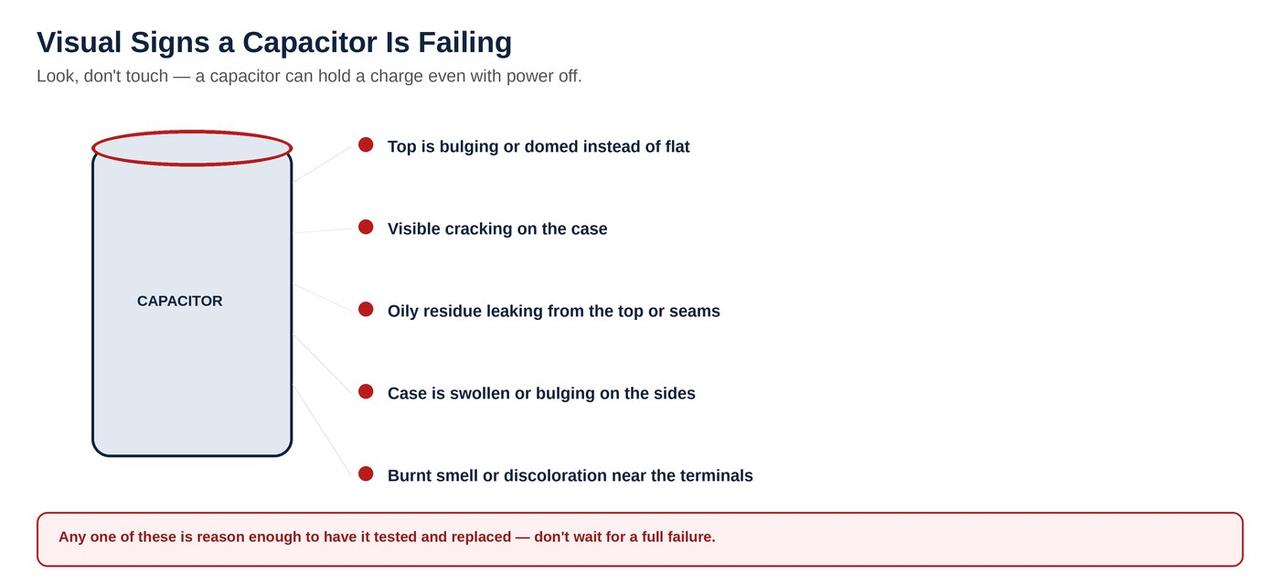
A bulging or domed top, visible cracking, leaking residue, case swelling, or a burnt smell near the terminals.
Can I test a capacitor myself?
It involves working near a component that can hold a dangerous charge, so this should be left to a licensed technician.
Is a failed capacitor expensive to fix?
No. It's one of the most affordable common AC repairs, typically $150-$350.
Does a failing capacitor mean my whole system is failing?
No. It's a normal wear part, especially in Texas heat, and doesn't reflect on the rest of the system's condition.
Can short cycling wear out a capacitor faster?
Yes. Frequent starts add electrical stress with every cycle.
Should I replace a capacitor before it fully fails?
If testing shows it's close to its rated tolerance, replacing it proactively can prevent an emergency no-cool situation.
Can poor airflow around the unit affect the capacitor?
Yes. Vegetation or fencing that traps heat around the cabinet adds to thermal stress.
Is capacitor testing part of routine maintenance?
Yes, it should be checked at every seasonal maintenance visit.
What happens when a capacitor fully fails?
It typically prevents the compressor or fan motor from starting, producing a humming, no-start symptom.
When should I call an HVAC technician?
Call if you notice slow starts, humming, or any visible bulging or leaking on the capacitor.