
AC Contactor Not Working
The contactor is the switch that lets a low-voltage thermostat signal control the high-voltage power going to your compressor and fan. When it fails, it can fail two very different ways — stuck open, so nothing starts, or stuck closed, so the outdoor unit won't shut off even from the thermostat.
Both failure modes are common, and both point to the same worn part.
Texas HVAC License TACLB43277C.
What This Guide Covers
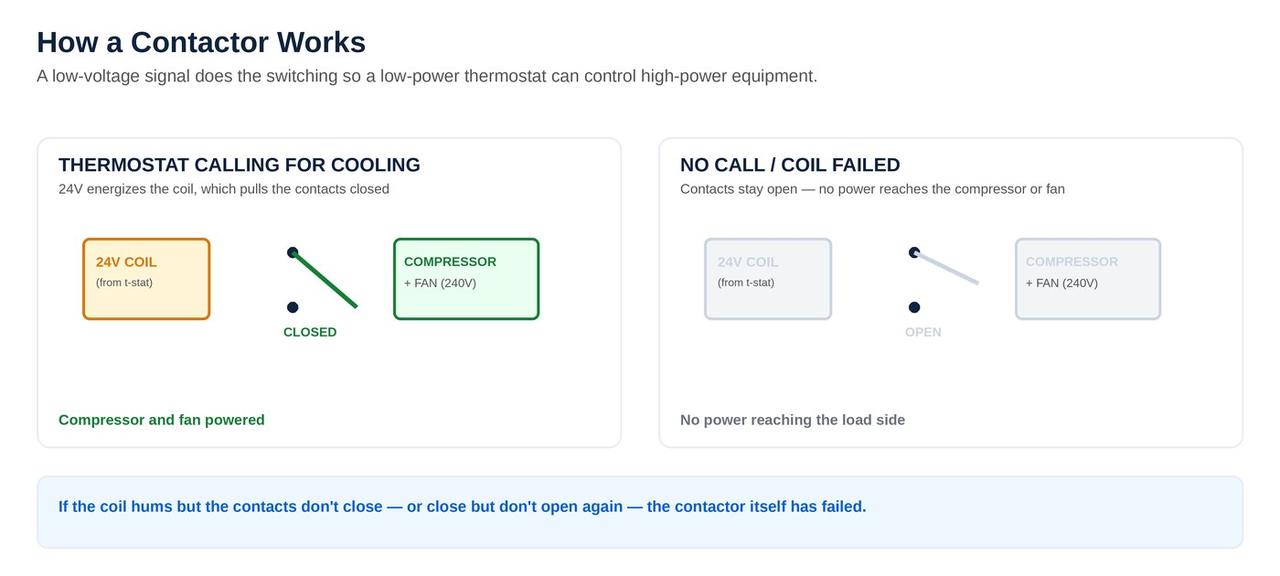
How a Contactor Works
Your thermostat only handles 24 volts — nowhere near enough to run a compressor directly. The contactor bridges that gap: the low-voltage signal energizes a coil, which mechanically pulls a set of contacts closed, completing the 240-volt circuit to the compressor and fan.
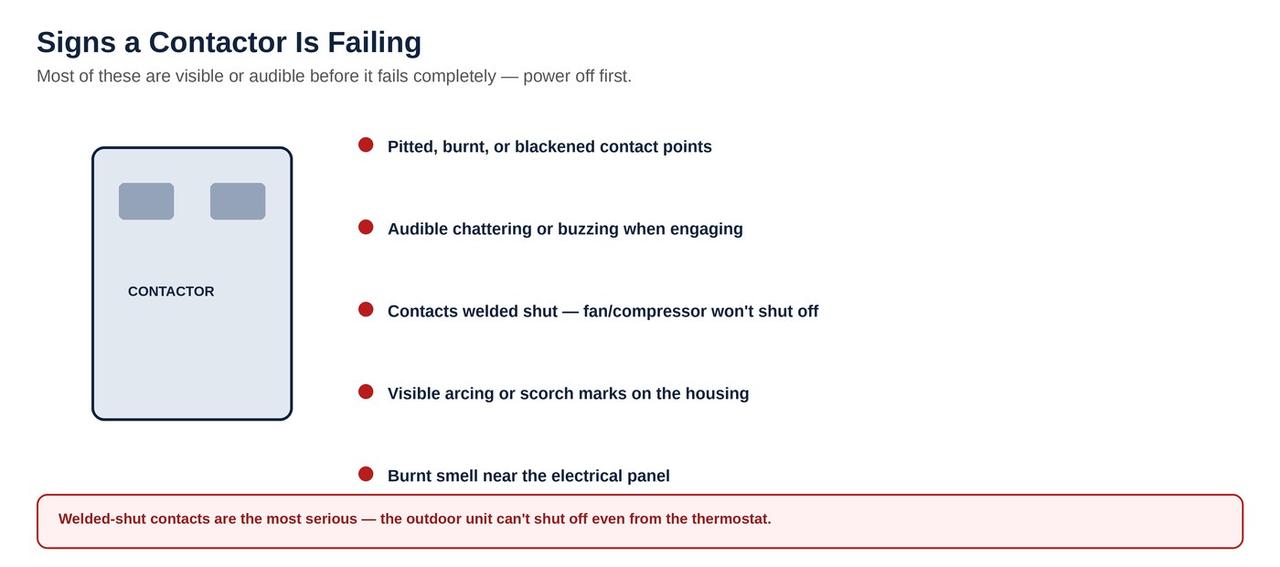
Signs a Contactor Is Failing
The Two Failure Modes
| Clue | Stuck open (no start) | Welded shut (no stop) |
|---|---|---|
| Symptom | Compressor and fan never turn on | Outdoor unit runs continuously, even with the thermostat satisfied or off |
| Cause | Worn coil, pitted contacts that won't close, or no 24V signal | Contacts fused together from arcing and heat over time |
| Urgency | Inconvenient — no cooling | Can run up energy bills fast and stress the compressor |
| Fix | Replace the contactor | Replace the contactor immediately |
What Causes a Contactor to Fail?
- Normal wear from repeated start-stop cycling
- Arcing across the contacts every time they open or close
- Corrosion or moisture intrusion in the electrical cabinet
- Insects or debris interfering with contact closure
- A failing capacitor forcing repeated hard starts that stress the contactor
- General age — it's a wear part like any mechanical switch
How a Technician Tests a Contactor
- Verify 24V signal is reaching the coil
- Inspect contact points for pitting, burning, or welding
- Measure voltage drop across closed contacts
- Check coil resistance
- Confirm the contactor fully opens when the call for cooling ends
- Inspect surrounding wiring and terminals for heat damage
How Contactor Problems Are Repaired
- Replace a pitted, burnt, or welded contactor
- Repair or replace damaged wiring or terminals
- Address a failing capacitor if it's been forcing hard starts
- Verify full system operation after replacement
Repair or Replace?
Contactor replacement is a routine, inexpensive electrical repair — it doesn't reflect on the condition of the rest of the system. If a welded contactor ran the compressor continuously for an extended period, that's worth having checked for any resulting compressor stress.
Contactor Problems in Spring or The Woodlands?
AC Repair Expo Heating & Cooling Inc diagnoses and repairs contactor problems throughout Spring, The Woodlands, Tomball, Cypress, Conroe, Humble, Kingwood, and nearby North Houston.
- Contactor and coil testing
- Same-day replacement available
- Full electrical inspection
- Capacitor testing included
- Honest, tested recommendations
Frequently Asked Questions
What does an AC contactor do?
It's the switch that lets a low-voltage thermostat signal control the high-voltage power to the compressor and fan.
What are the signs of a bad contactor?
Pitted or burnt contacts, chattering or buzzing, contacts welded shut, visible arcing, or a burnt smell near the panel.
Why won't my AC turn off?
A contactor with contacts welded shut can keep the outdoor unit running even after the thermostat is satisfied.
Why won't my AC turn on at all?
A contactor that won't close — from a worn coil or pitted contacts — prevents power from ever reaching the compressor.
Can a bad capacitor damage the contactor?
Yes. Repeated hard starts caused by a weak capacitor add extra stress to the contactor over time.
Is it safe to test a contactor myself?
No. It involves working inside an energized electrical panel and should be left to a licensed technician.
How much does contactor replacement cost?
It's a relatively affordable, routine electrical repair.
Can a contactor cause high electric bills?
Yes, if it's welded shut and the outdoor unit is running continuously without your knowledge.
Is a chattering contactor an emergency?
Not usually an emergency, but it should be addressed before it fails completely.
How long does a contactor last?
It varies with cycling frequency, but it's a wear part that eventually needs replacement on every system.
Does a bad contactor mean I need a new AC?
No. It's a routine component replacement that doesn't reflect on the rest of the system.
When should I call an HVAC technician?
Call if the outdoor unit won't start, won't stop, or you hear chattering, buzzing, or smell anything burning near the panel.