
Blower Motor Troubleshooting
The blower motor is what actually moves air through your entire system — when it's struggling, the symptom you notice depends heavily on which part of the assembly is actually failing. A silent blower, a noisy one, and an overheating one all point in very different directions.
Matching the exact symptom to the right component is what separates a quick, affordable repair from an expensive guess.
Texas HVAC License TACLB43277C.
What This Guide Covers
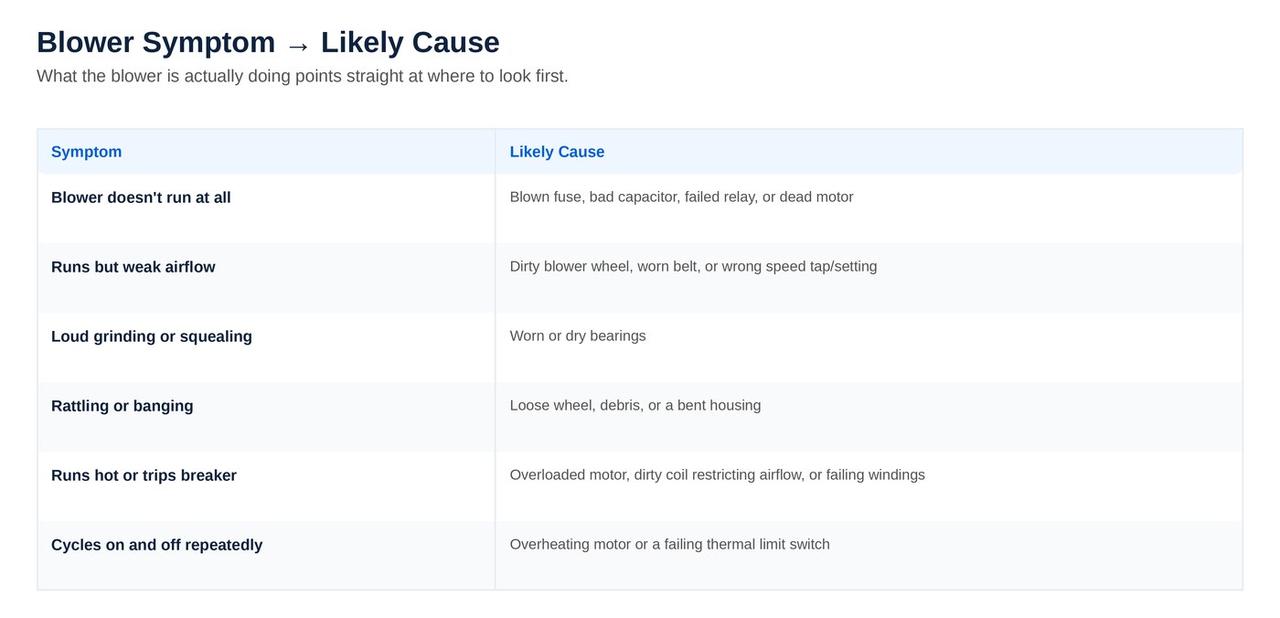
Blower Symptom → Likely Cause
What Can Fail in the Blower Assembly
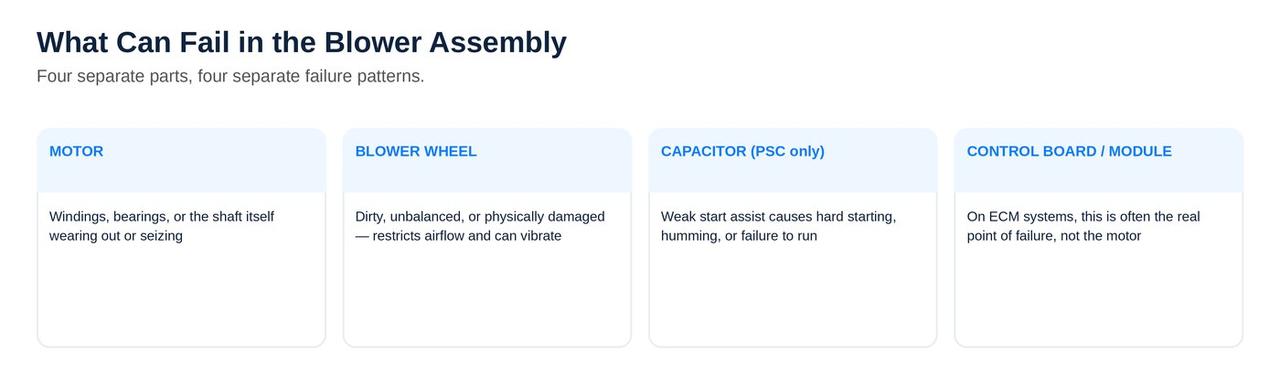
The blower isn't a single part — it's a motor, a wheel, and either a capacitor or a control module working together. Knowing which system type you have changes where the likely failure actually is.
No Airflow at All
- Blown fuse or tripped breaker
- Failed capacitor (PSC systems)
- Failed control module (ECM systems)
- Bad relay or contactor on the low-voltage side
- Seized motor bearings
- Completely failed motor windings
Weak Airflow With the Blower Running
- Dirty or clogged blower wheel
- Incorrect speed tap or module setting
- Restricted airflow elsewhere in the system pulling the motor's effective output down
- Worn belt on belt-driven assemblies
Noise From the Blower
| Sound | Likely cause |
|---|---|
| Grinding or squealing | Worn or dry motor bearings |
| Rattling or banging | Loose blower wheel, debris, or a bent housing panel |
| Humming without running | Weak capacitor or a stuck motor |
| Clicking on startup | Relay or contactor chatter, or a failing start component |
How a Technician Diagnoses a Blower Motor Problem
- Verify voltage is reaching the motor
- Test the capacitor, if the system uses one
- Check the control module and error codes on ECM systems
- Inspect the blower wheel for dirt, damage, or imbalance
- Listen and observe startup behavior
- Measure motor amperage against its rated draw
- Inspect bearings for play or resistance
How Blower Motor Problems Are Repaired
- Replace a failed capacitor or control module
- Clean or replace a dirty or damaged blower wheel
- Replace worn motor bearings or the motor itself
- Repair a failed relay or contactor
- Correct incorrect speed settings
Repair or Replace?
Many blower problems are resolved by replacing a single failed component — a capacitor, a module, or the wheel — rather than the entire assembly. Full motor replacement becomes necessary when the windings or bearings themselves have failed.
Blower Motor Problems in Spring or The Woodlands?
AC Repair Expo Heating & Cooling Inc diagnoses blower motor problems throughout Spring, The Woodlands, Tomball, Cypress, Conroe, Humble, Kingwood, and nearby North Houston.
- Motor, capacitor, and module testing
- Blower wheel inspection and cleaning
- Bearing and amperage testing
- Same-day service available
- Honest, tested recommendations
Frequently Asked Questions
Why won't my blower motor run?
Common causes include a blown fuse, failed capacitor or control module, bad relay, or a seized or failed motor.
Why is my blower running but airflow is weak?
A dirty blower wheel, wrong speed setting, or a restriction elsewhere in the system are common causes.
What does grinding or squealing from the blower mean?
It usually points to worn or dry motor bearings.
Can a bad capacitor cause blower problems?
Yes, on PSC systems. A weak capacitor can prevent the motor from starting or running properly.
Is it always the motor itself that fails?
No. The capacitor, control module, blower wheel, or a relay can each fail independently of the motor windings.
Can a dirty blower wheel really cause weak airflow?
Yes. A caked or unbalanced wheel significantly reduces how much air it can move.
Should I try to diagnose blower noise myself?
Identifying the type of sound is useful information to share, but testing and repair should be left to a technician.
Can a blower motor trip the breaker?
Yes, if it's drawing excessive current from worn bearings, failing windings, or a restricted airflow path.
Why does my blower cycle on and off?
That often points to overheating or a failing thermal limit switch protecting the motor.
How much does blower motor repair cost?
It varies significantly depending on whether the fix is a capacitor, module, or a full motor replacement.
Is blower troubleshooting different for ECM vs. PSC systems?
Yes. ECM problems more often trace to the control module, while PSC problems more often trace to the capacitor or windings.
When should I call an HVAC technician?
Call if the blower won't run, sounds abnormal, or airflow feels weak despite the system running.