
ECM Blower Motor Guide
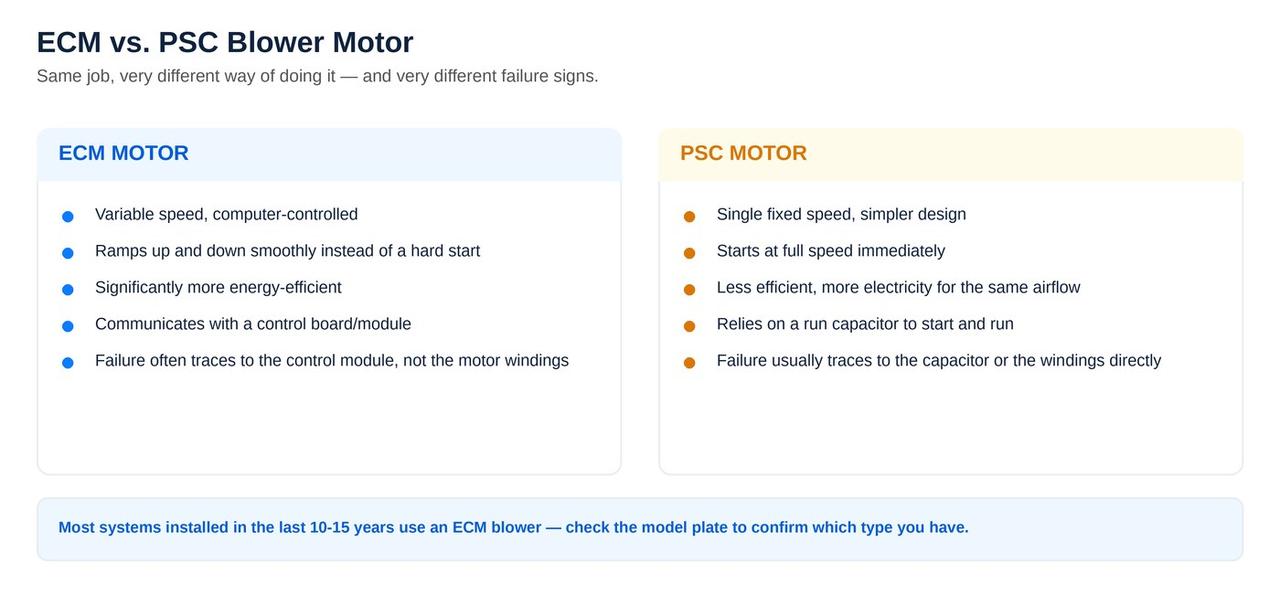
An ECM (electronically commutated motor) blower is the variable-speed, computer-controlled motor found in most systems installed over the last decade or so. It ramps smoothly up and down instead of snapping straight to full speed, and it's significantly more efficient than the older PSC motors it replaced.
When something goes wrong, the cause is more often the electronic control module than the motor windings themselves — a very different diagnosis than a traditional blower motor.
Texas HVAC License TACLB43277C.
What This Guide Covers
ECM vs. PSC Blower Motor
The Soft Ramp Is the Tell
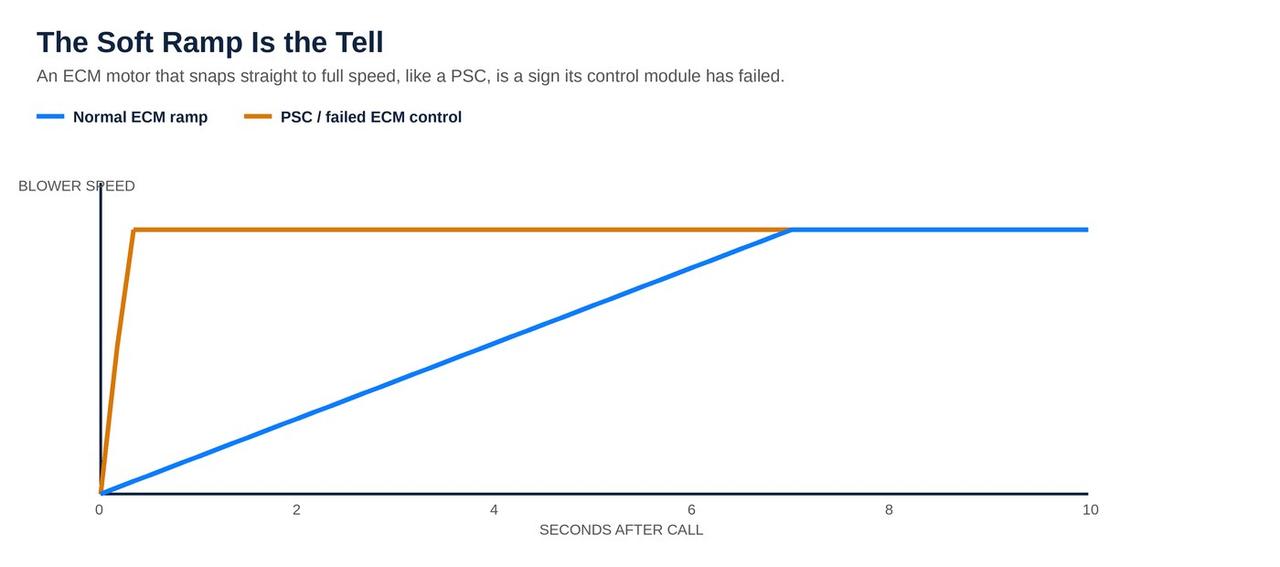
A healthy ECM motor gradually increases speed over several seconds after a call for airflow — that's the control module doing its job. If an ECM-equipped system suddenly snaps straight to full speed like an old PSC motor, that's a strong sign the control module itself has failed and the motor has fallen back to a basic default mode.
Symptoms of a Failing ECM Blower
No Ramp-Up
The motor jumps straight to full speed instead of the normal gradual increase.
Blower Won't Run at All
A failed control module can prevent the motor from starting entirely.
Humming or Clicking
The motor may attempt to start without successfully spinning up.
Intermittent Operation
The blower may run, stop, and restart unpredictably.
Error Codes on the Board
Many systems display a fault code that points directly at the module or motor.
Reduced Airflow at All Speeds
A struggling motor may run but never reach its programmed speeds.
How a Technician Diagnoses an ECM Blower Problem
- Check for stored fault or error codes on the control board
- Verify incoming voltage to the motor and module
- Inspect wiring harness connections for damage or corrosion
- Observe startup behavior for a normal ramp versus an instant jump
- Test the module separately from the motor when possible
- Measure current draw at various commanded speeds
How ECM Blower Problems Are Repaired
- Replace a failed control module without replacing the motor
- Replace the motor if the windings themselves have failed
- Repair damaged wiring harness connections
- Update or reprogram module settings when applicable
- Verify normal ramp behavior after any repair
Repair or Replace?
Because the module and motor are separate parts, an ECM blower repair often only requires replacing the failed component rather than the entire assembly. Full blower replacement becomes more relevant when the motor windings themselves are damaged or the assembly is significantly outdated.
ECM Blower Problems in Spring or The Woodlands?
AC Repair Expo Heating & Cooling Inc diagnoses ECM and PSC blower motors throughout Spring, The Woodlands, Tomball, Cypress, Conroe, Humble, Kingwood, and nearby North Houston.
- Control module and motor testing
- Error code diagnosis
- Wiring harness inspection
- Same-day service available
- Honest, tested recommendations
Frequently Asked Questions
What is an ECM blower motor?
It's a variable-speed, electronically commutated motor controlled by a module, common in systems installed over roughly the last decade or more.
How is an ECM different from a PSC motor?
An ECM is variable speed, ramps up smoothly, and is more efficient; a PSC is fixed speed and starts instantly at full speed using a run capacitor.
Why does my blower snap to full speed instead of ramping up?
That's often a sign the control module has failed and the motor has fallen back to a basic operating mode.
Can an ECM motor fail without the windings being bad?
Yes. The control module is a separate component and is a very common point of failure on its own.
Are ECM motors more expensive to repair?
Parts can cost more than PSC equivalents, but repairs are often limited to just the failed module rather than the whole motor.
Can error codes help diagnose ECM problems?
Yes. Many systems display a specific fault code that helps identify whether the issue is the module, motor, or wiring.
Is an ECM motor worth the extra cost?
For most homeowners, yes — the efficiency gains and quieter, more consistent airflow are significant over the system's lifetime.
Can wiring problems cause ECM blower symptoms?
Yes. A damaged or corroded harness connection can mimic module or motor failure.
Should I try to diagnose this myself?
ECM diagnosis involves electronic components and should be handled by a licensed technician.
Can an ECM blower run at the wrong speed?
Yes, if the module is misconfigured or partially failing, it may not reach its programmed speeds.
How long do ECM motors typically last?
They're generally durable, but like any component, the module or motor can eventually fail from age or electrical stress.
When should I call an HVAC technician?
Call if the blower isn't ramping normally, won't start, or you notice a fault code on the control board.