
High Head Pressure in an AC System
High head pressure means the refrigerant pressure on the high side of an AC system is above the expected range for current conditions. Common causes include poor condenser airflow, refrigerant overcharge, non-condensable gases, restrictions, air recirculation, and extreme outdoor heat.
High pressure raises compressor amperage and temperature, reduces efficiency, and may trip pressure or overload protection.
Texas HVAC License TACLB43277C.
What This Guide Covers
What Is Head Pressure?
Head pressure is the high-side pressure measured near the compressor discharge or liquid service port. It reflects how effectively the condenser rejects heat outdoors.
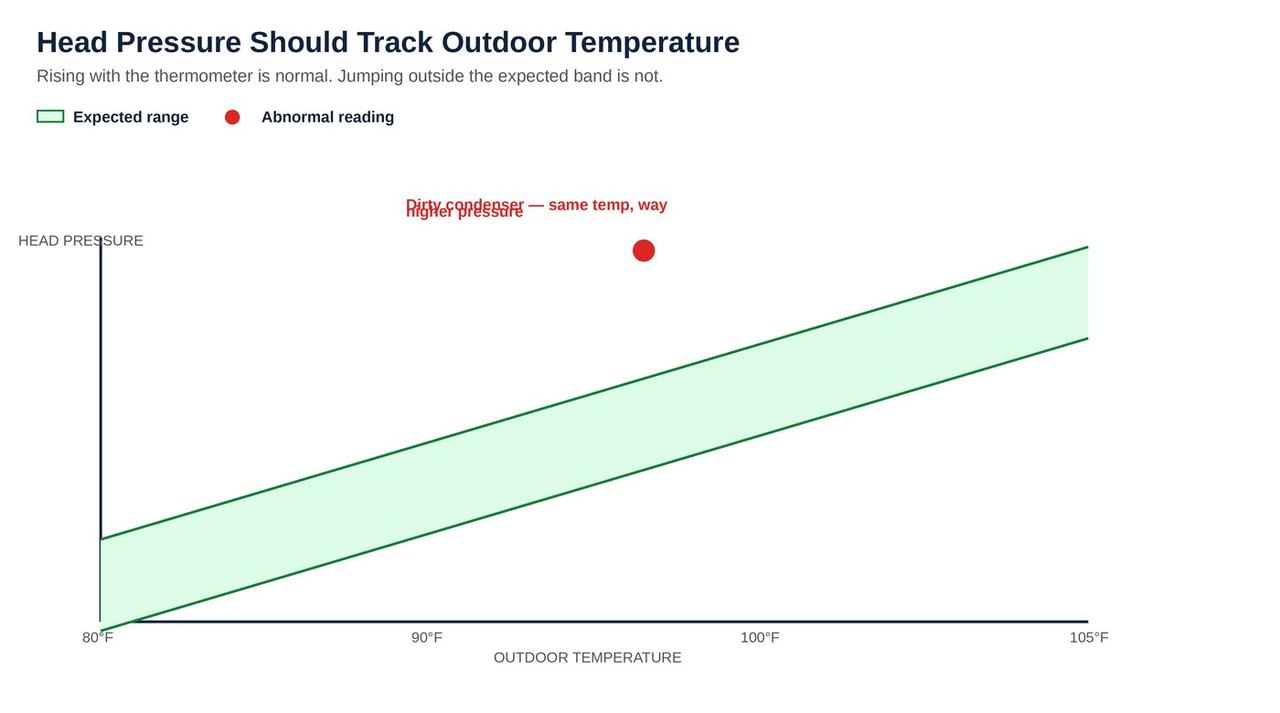
Technicians convert pressure to saturation temperature and compare condensing temperature with outdoor air temperature. Refrigerant type, outdoor temperature, indoor load, airflow, charge, and coil design all matter.
Common Symptoms of High Head Pressure
High Compressor Amperage
The compressor works harder against elevated discharge pressure.
Weak Cooling
Capacity and efficiency may fall as the system becomes pressure-stressed.
High-Pressure Trips
Protective controls may stop the outdoor unit.
Hot Compressor
Higher compression ratio and current increase motor temperature.
Long Run Times
The AC may struggle to satisfy the thermostat.
Breaker or Overload Trips
Excessive current and heat may interrupt operation.
12 Causes of High Head Pressure
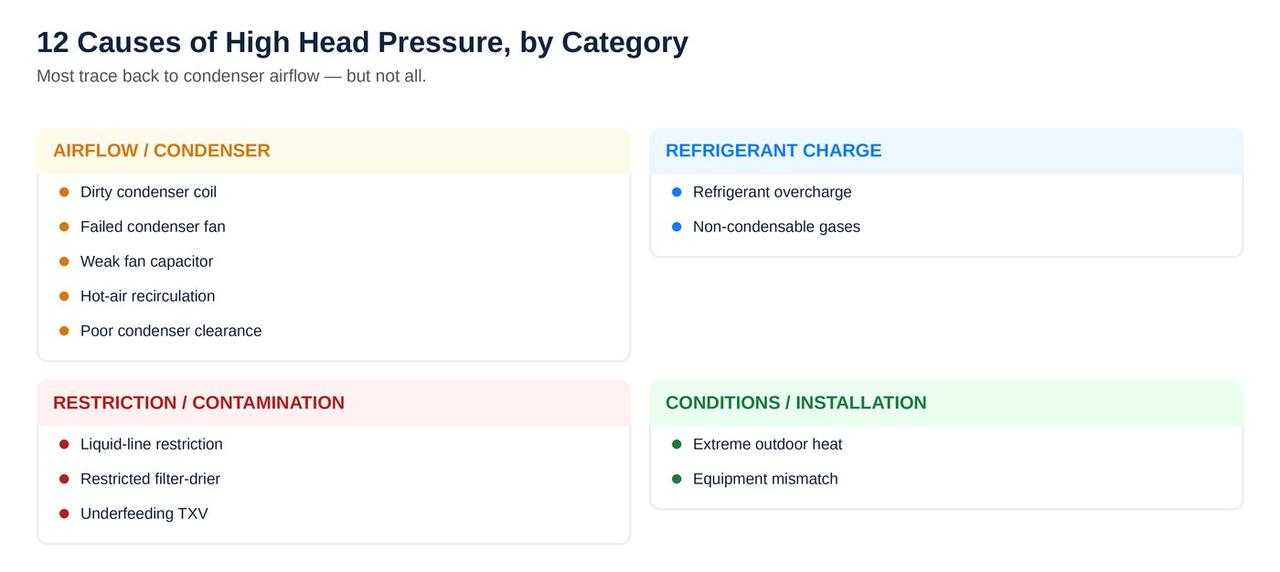
1. Dirty Condenser Coil
Dirt, grass, lint, and debris reduce heat transfer.
2. Failed Condenser Fan
Low airflow prevents effective heat rejection.
3. Weak Fan Capacitor
The fan may start late, run slowly, or stop in peak heat.
4. Refrigerant Overcharge
Excess liquid occupies condenser volume and raises pressure.
5. Non-Condensable Gases
Air or other gases add pressure without condensing normally.
6. Hot-Air Recirculation
Discharge air may be pulled back through the coil.
7. Extreme Outdoor Heat
Texas summer temperatures naturally increase condensing pressure.
8. Liquid-Line Restriction
A restriction can back liquid refrigerant into the condenser.
9. Restricted Filter-Drier
Contamination may create pressure and temperature drop.
10. Underfeeding TXV
A restriction at the TXV can increase condenser liquid inventory.
11. Poor Condenser Clearance
Walls, fences, vegetation, and nearby units may restrict airflow.
12. Equipment Mismatch
Incorrectly matched coils, compressors, or controls can create abnormal operation.
Dirty Condenser Coil and Fan Problems
A dirty coil or weak fan is among the most common high-pressure causes. The technician should inspect both sides of the coil, verify airflow direction, test the fan capacitor, measure motor amperage, and check whether the fan slows or stops as it heats.
High Head Pressure Diagnostic Comparisons
| Pattern | Likely clues |
|---|---|
| Overcharge | High head pressure, often high subcooling, normal condenser airflow, charge above manufacturer requirement |
| Dirty condenser or weak fan | High head pressure and amperage; visible restriction or low airflow; readings improve after correction |
| Non-condensables | Pressure-temperature relationship appears abnormal, often after poor evacuation or recent open-system work |
| Liquid-line restriction | High or normal subcooling, high superheat, low suction, and temperature drop at the restricted point |
| Extreme outdoor heat | Pressure rises with ambient temperature but should remain within expected design conditions |
High Head Pressure vs. Refrigerant Overcharge
Overcharge is only one possible cause. Before refrigerant is removed, the technician should verify condenser cleanliness, fan performance, outdoor temperature, airflow, line-set requirements, superheat, subcooling, and charge history.
Non-Condensables and Refrigerant Restrictions
Air can enter the circuit through poor evacuation or service practices. Correction may require full recovery, deep evacuation, and recharging with known-correct refrigerant.
A filter-drier, kinked liquid line, partially closed valve, TXV inlet screen, piston, or distributor restriction can also cause liquid to back up and raise subcooling.
How a Technician Diagnoses High Head Pressure
- Identify refrigerant type and outdoor temperature
- Inspect the condenser coil and clearances
- Verify fan speed, direction, capacitor, and motor amperage
- Measure high- and low-side pressures
- Convert pressures to saturation temperatures
- Calculate superheat and subcooling
- Measure compressor amperage
- Check for temperature drops across filter-driers and liquid lines
- Inspect for air recirculation
- Review charging and service history
- Compare readings with manufacturer targets
- Verify performance after correction
Can High Head Pressure Damage the Compressor?
Yes. Continued operation can cause high running amperage, motor overheating, thermal overload trips, winding damage, reduced oil quality, high-pressure shutdowns, and shorter compressor life.
How High Head Pressure Is Corrected
- Clean the condenser coil
- Repair or replace the fan motor
- Replace a weak fan capacitor
- Recover excess refrigerant
- Remove non-condensables through recovery and evacuation
- Correct hot-air recirculation
- Replace a restricted filter-drier
- Repair liquid-line or TXV restrictions
Repair or Replace?
Most high-pressure causes are repairable. Replacement becomes more relevant when the compressor is damaged, the condenser coil is badly deteriorated, the equipment is old and out of warranty, or several major components are failing.
High Head Pressure in Spring or The Woodlands?
AC Repair Expo Heating & Cooling Inc provides high-pressure and refrigerant diagnostics throughout Spring, The Woodlands, Tomball, Cypress, Conroe, Humble, Kingwood, and nearby North Houston.
- Condenser airflow diagnosis
- Fan and capacitor testing
- Superheat and subcooling checks
- Compressor amperage testing
- Restriction and overcharge diagnosis
Frequently Asked Questions
What causes high head pressure?
Dirty condenser coils, failed fans, overcharge, non-condensables, restrictions, recirculation, and extreme heat are common causes.
Can a dirty condenser cause it?
Yes. Reduced airflow and heat transfer raise condensing pressure.
Can overcharge cause it?
Yes. Excess refrigerant can occupy condenser volume and increase pressure.
Can a failed fan cause high pressure?
Yes. Without airflow, the condenser cannot reject heat.
Can non-condensables raise pressure?
Yes. Air and other gases add pressure and disrupt normal refrigerant behavior.
Can a restriction cause it?
Yes. A downstream restriction can back liquid into the condenser.
Can high outdoor heat cause it?
Pressure naturally rises with ambient temperature, but it should remain within expected design limits.
Can it trip the breaker?
Yes. Higher compressor amperage may trip a breaker or overload.
Can it damage the compressor?
Yes. It increases load, temperature, and winding stress.
How is the cause confirmed?
Technicians evaluate airflow, pressures, saturation temperatures, superheat, subcooling, amperage, and service history.
Should refrigerant be removed immediately?
Only after overcharge is confirmed. Removing refrigerant from a system with another fault can create a second problem.
When should I call for service?
Call when the outdoor unit shuts off, cooling is weak, the breaker trips, or the system repeatedly trips on high pressure.