Outside AC Fan Not Spinning?
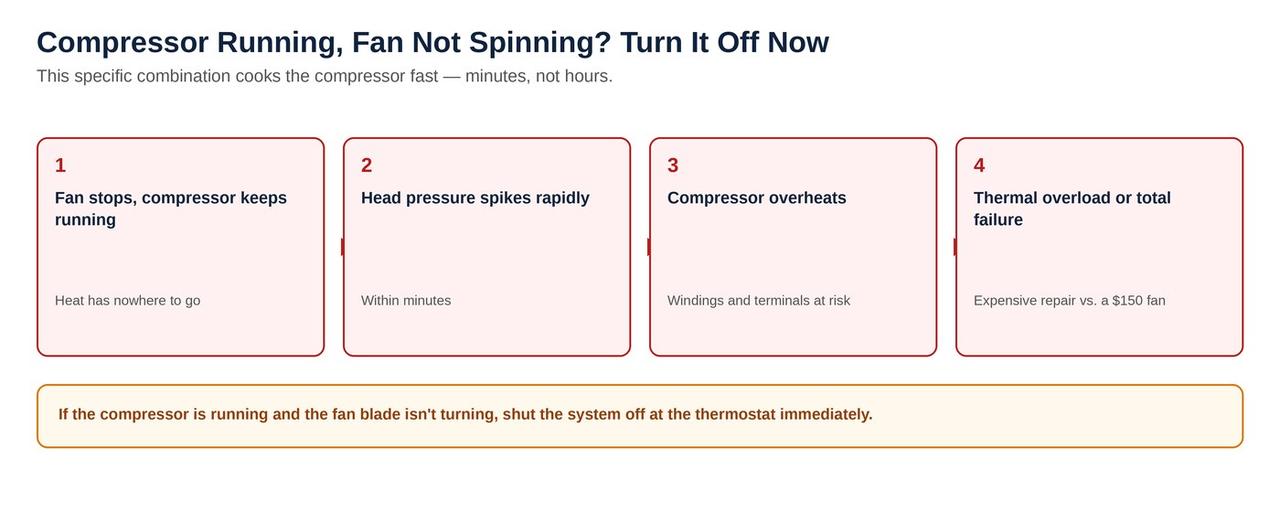
If the outside AC fan is not spinning, turn the cooling system off. The condenser fan removes heat from the outdoor coil. When it stops, refrigerant pressure and compressor temperature can rise quickly, especially during North Houston summer heat.
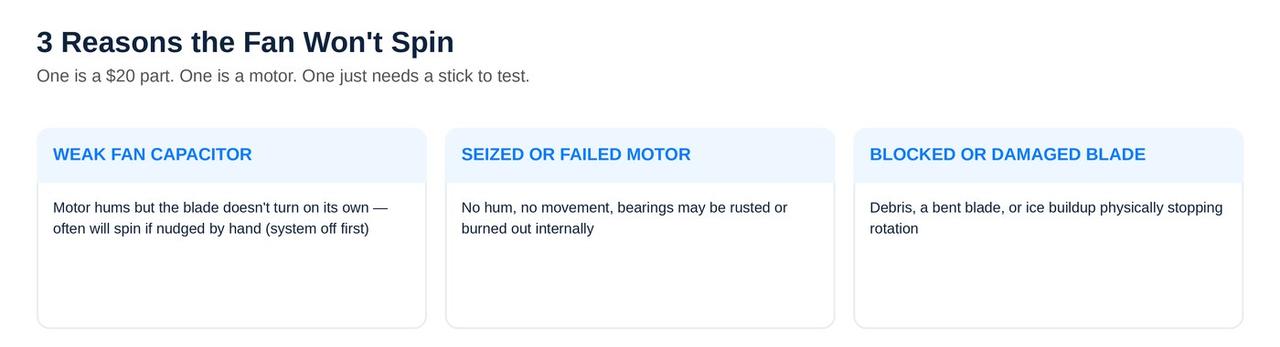
The cause may be a failed capacitor, bad condenser fan motor, contactor problem, damaged wiring, control issue, blocked fan blade, or loss of power. This guide explains the symptoms, safe homeowner checks, professional diagnosis, and repair considerations.
Licensed Texas HVAC contractor TACLB43277C. Serving Spring, The Woodlands, Tomball, Cypress, Conroe, Humble, Kingwood, and nearby North Houston communities.
What This Guide Covers
Why the Outside AC Fan Matters
The condenser fan pulls outdoor air through the condenser coil and helps release heat absorbed from inside the house. Without proper fan airflow, the coil cannot reject heat efficiently.
- Refrigerant pressure can rise.
- The compressor can overheat.
- Cooling capacity can drop sharply.
- The compressor may cycle on internal overload.
- The breaker may eventually trip.
- Continued operation may turn a smaller repair into a major repair.
Texas Technician Tip
During extreme heat, a condenser fan failure becomes urgent because the compressor is already operating under heavy thermal load. Turning the system off early can reduce the chance of additional compressor damage.
Safe Checks Before Calling for Service
- Turn cooling off: Set the thermostat to OFF so the compressor does not continue running without fan airflow.
- Check the thermostat: Confirm it was calling for cooling and the indoor blower was operating.
- Check the breaker once: Look for a tripped AC breaker. Do not repeatedly reset it.
- Inspect the outdoor unit: Look for leaves, sticks, plastic, or visible debris around the fan guard.
- Listen: Note whether the unit is silent, humming, buzzing, clicking, or attempting to start.
- Look for heat or odor: Burning smells, melted wiring, smoke, or severe electrical noise require immediate service.
8 Common Causes of an Outside AC Fan Not Spinning
1. Failed Dual-Run Capacitor
The capacitor helps the condenser fan motor and compressor start and run. A weak or failed fan section can leave the compressor running while the fan remains stopped.
- Outdoor unit hums
- Fan starts intermittently
- Fan motor struggles during startup
- Capacitor is swollen or leaking
- Failure appears during very hot weather
2. Failed Condenser Fan Motor
The fan motor may fail electrically, overheat internally, seize mechanically, or develop worn bearings. Some motors stop when hot and restart after cooling.
- Motor is extremely hot
- Fan runs slowly
- Grinding or squealing noise
- Fan stops after several minutes
- Correct capacitor is present but motor will not run
3. Contactor or High-Voltage Power Problem
The contactor sends power to both the compressor and outdoor fan. Burned contacts, loose terminals, or a failed contactor can interrupt power to one or both components.
- No click from the outdoor unit
- Buzzing or chattering contactor
- Burned terminals
- Intermittent operation
- Compressor and fan both remain off
4. Loose, Burned, or Broken Wiring
Vibration, heat, corrosion, insects, and previous repairs can damage fan-motor wiring or terminals.
- Intermittent fan operation
- Visible discoloration
- Melted connectors
- Burning smell
- Fan stops when the cabinet vibrates
5. Blocked or Damaged Fan Blade
Debris, a bent fan blade, damaged shroud, loose motor mount, or failed bearing can prevent the fan from turning freely.
- Scraping or banging
- Fan blade visibly off-center
- Debris under the guard
- Motor hums but blade does not move
- Heavy vibration when the fan attempts to start
6. Motor Thermal Overload
A hot fan motor may shut itself off on internal overload and restart after it cools. The underlying cause may be a weak capacitor, failing bearings, incorrect motor, high ambient temperature, or restricted airflow.
- Fan works when cool
- Stops during peak afternoon heat
- Restarts later
- Motor shell is extremely hot
- Problem becomes more frequent
7. Control Board, Relay, or Low-Voltage Problem
Some systems use control boards, fan relays, pressure switches, or communicating controls that affect outdoor fan operation.
- Fan operation is inconsistent
- Diagnostic fault code is present
- Contactor does not receive proper signal
- Low-voltage fuse opens
- Problem began after wiring or thermostat work
8. Loss of Power or Tripped Breaker
A tripped breaker, pulled disconnect, failed fuse, loose disconnect connection, or utility voltage problem can stop the outdoor unit.
- Outdoor unit is completely silent
- Indoor blower still runs
- Breaker is tripped
- Disconnect shows heat damage
- Failure occurred after a surge or outage
What If the Compressor Is Running but the Fan Is Not?
This condition needs immediate attention. The compressor may sound like a deep hum or vibration while the fan blade remains still. Without condenser airflow, operating pressure and compressor temperature can rise quickly.
Common causes include:
- Failed fan side of a dual-run capacitor
- Failed condenser fan motor
- Open fan-motor winding
- Loose or burned fan wiring
- Motor thermal overload
- Control or relay problem on certain systems
A technician should also check whether the compressor was exposed to excessive temperature or pressure before restoring normal operation.
What Different Outdoor Fan Symptoms May Mean
| Symptom | Possible causes | Best next step |
|---|---|---|
| Outdoor unit hums but fan does not spin | Weak capacitor, seized motor, blocked blade, compressor attempting to start | Turn cooling off and schedule electrical testing. |
| Fan runs slowly | Weak capacitor, failing motor, incorrect motor setup, voltage problem | Test capacitance, voltage, motor current, and rotation. |
| Fan starts, then stops when hot | Motor thermal overload, worn bearings, wrong capacitor, overheating | Test motor under operating temperature and load. |
| Fan and compressor are both off | Contactor, breaker, disconnect, thermostat, float switch, control fault | Check power and control circuit. |
| Compressor runs but fan is off | Fan capacitor, fan motor, fan wiring, relay or control fault | Turn system off immediately to protect the compressor. |
| Fan makes scraping or banging noise | Bent blade, loose mount, damaged shroud, failing bearing | Leave system off to prevent mechanical damage. |
| Breaker trips when fan tries to start | Shorted motor, seized motor, damaged wiring, capacitor issue | Do not reset repeatedly; schedule service. |
Bad Capacitor vs. Bad Condenser Fan Motor
Signs That Point Toward the Capacitor
- Fan and compressor have startup trouble
- Problem is worse during peak heat
- Capacitor is visibly swollen or leaking
- Capacitance tests below rating
- Motor runs normally after the correct capacitor is installed
Signs That Point Toward the Motor
- Motor windings test open or shorted
- Motor draws abnormal current
- Bearings are tight or noisy
- Motor overheats with the correct capacitor
- Fan stops after warming up
How a Technician Diagnoses an Outdoor Fan That Will Not Run
- Confirm the thermostat is calling for cooling
- Verify line voltage at the disconnect and contactor
- Inspect the breaker, disconnect, fuses, and terminals
- Check whether the contactor is energized and closing properly
- Test the dual-run capacitor against its rated microfarads
- Inspect fan-motor wiring and connectors
- Check motor winding resistance and shorts to ground
- Measure fan-motor current
- Inspect blade condition, rotation, pitch, and clearance
- Check motor temperature and thermal-overload behavior
- Verify compressor current and operating condition
- Check refrigerant pressures and condenser performance after repair
Complete Diagnosis Matters
Replacing only the visibly failed part may not solve the underlying cause. A weak capacitor, dirty condenser coil, incorrect replacement motor, loose connection, or abnormal compressor load can contribute to repeat failures.
Can a Dirty Condenser Coil Stop the Fan?
A dirty condenser coil does not usually prevent the motor from receiving power, but it can raise operating temperature and system pressure. That added heat can expose a weak capacitor, cause a marginal fan motor to cycle on thermal overload, and increase compressor stress.
The coil should be inspected when the fan fails, especially if:
- The outdoor unit is packed with grass or cottonwood
- The fan motor is extremely hot
- The system runs for long periods
- Cooling performance was declining before the fan stopped
- The problem happens mainly during afternoon heat
Does an Outdoor Fan Failure Mean You Need a New AC?
Usually not. A failed capacitor, contactor, fan motor, wiring connection, relay, or fan blade can often be repaired without replacing the entire system.
Replacement becomes more relevant when:
- The compressor was damaged from overheating
- The system has multiple major failures
- The equipment is near or beyond its expected service life
- The motor or compressor is obsolete and expensive to source
- The condenser coil is severely deteriorated
- The system uses an older refrigerant and needs a major sealed-system repair
- Repair cost is high compared with the remaining value of the equipment
Outside AC Fan Not Spinning in Spring or The Woodlands?
AC Repair Expo Heating & Cooling Inc provides outdoor-unit and no-cooling diagnostics throughout Spring, The Woodlands, Tomball, Cypress, Conroe, Humble, Kingwood, and nearby North Houston communities.
Our licensed technicians test capacitors, condenser fan motors, contactors, wiring, breakers, disconnects, compressor current, refrigerant performance, and complete system operation before recommending repair or replacement.
Texas HVAC License TACLB43277C- Capacitor and fan-motor testing
- Contactor and voltage checks
- Wiring and terminal inspection
- Compressor protection evaluation
- Condenser coil and airflow review
- Clear repair-versus-replacement options
Frequently Asked Questions
Can I run my AC if the outside fan is not spinning?
No. Turn cooling off. Running the compressor without condenser airflow can raise pressure and temperature and may damage the compressor.
Why is my outside AC unit humming but the fan is not spinning?
Common causes include a weak capacitor, failed fan motor, blocked blade, contactor problem, or compressor startup problem.
Does a bad capacitor stop the outside fan?
Yes. A failed fan section of a dual-run capacitor can prevent the condenser fan motor from starting or running correctly.
Can the compressor run while the outside fan is off?
Yes. This often happens when the fan capacitor, motor, wiring, or fan-control circuit fails. Turn the system off immediately.
Why does the outside fan start and then stop?
The motor may be overheating and opening its internal thermal overload. A weak capacitor, worn bearings, incorrect motor setup, or excessive heat may be responsible.
Can a dirty condenser coil cause the fan motor to overheat?
Yes. Restricted heat rejection can increase operating temperature and stress a weak or aging fan motor.
Should I push the fan blade to start it?
No. The fan can start unexpectedly, and the outdoor unit contains dangerous voltage. This is not a safe homeowner test.
Can a bad contactor stop only the fan?
It can, especially when contacts or terminals are burned or voltage is not reaching the fan circuit correctly.
Can a bad fan motor trip the breaker?
Yes. A seized, shorted, or electrically failing motor may draw excessive current and trip the breaker.
How do technicians tell whether the capacitor or motor is bad?
They test capacitor value, voltage, motor windings, current draw, wiring, blade movement, and motor temperature.
Does an outdoor fan failure mean I need a new AC system?
Usually not. Capacitors, motors, contactors, wiring, and fan blades are commonly replaceable components.
When should I call an HVAC technician?
Call when the fan does not run, the unit hums, the compressor operates without the fan, the breaker trips, or you notice burning smells or damaged wiring.