
AC Compressor Locked Rotor Symptoms
A locked rotor means the compressor motor is receiving power but cannot begin rotating. The compressor may hum loudly, draw very high startup current, dim lights, trip the breaker, or open its internal thermal overload.
Some hard-starting compressors can still operate with the right correction. Others are mechanically locked or electrically damaged and require compressor or system replacement.
Licensed Texas HVAC contractor TACLB43277C. Serving Spring, The Woodlands, Tomball, Cypress, Conroe, Humble, Kingwood, and nearby North Houston communities.
What This Guide Covers
What Does Locked Rotor Mean?
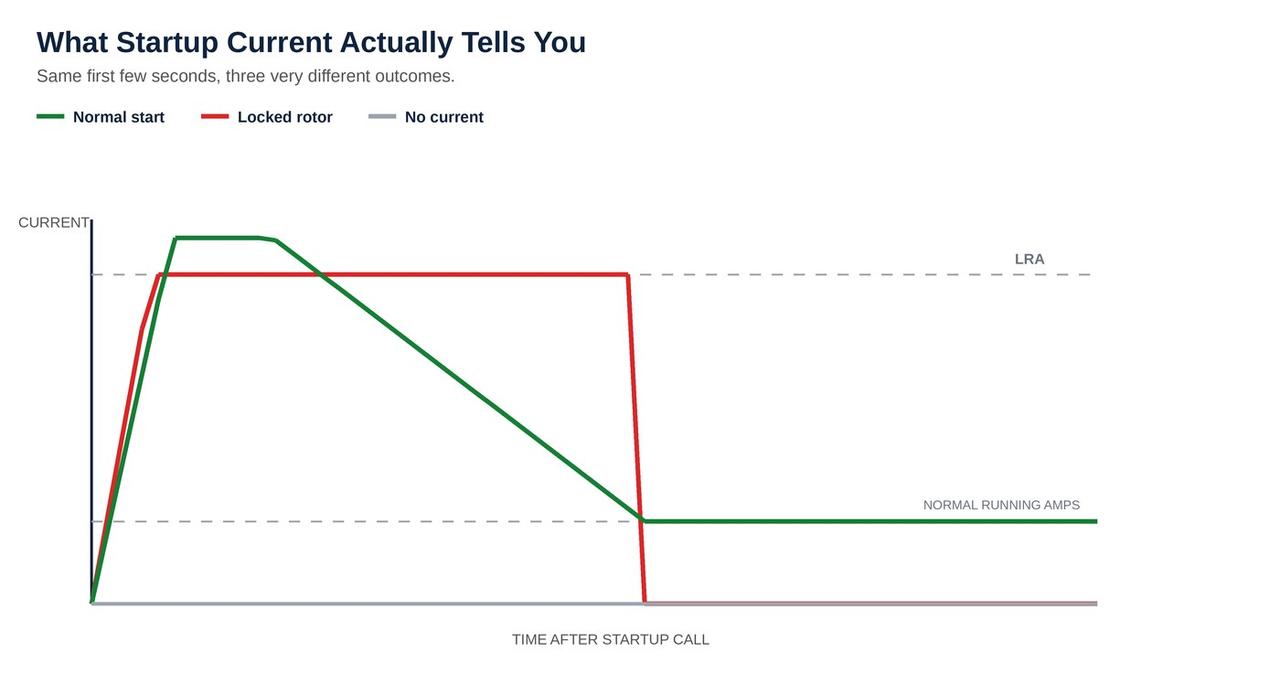
When an electric motor starts, the rotor must begin turning almost immediately. During that brief moment, current is much higher than normal running current.
If the compressor cannot begin rotating, current remains near locked-rotor amperage until:
- The breaker trips
- The internal overload opens
- A protective control interrupts power
- The wiring or terminal overheats
Locked Rotor vs. Hard Starting
A hard-starting compressor may still start with corrected voltage, a proper capacitor, or approved start assistance. A fully locked compressor remains unable to rotate despite correct electrical conditions.
10 Common Locked-Rotor Symptoms
1. Deep Humming Sound
The compressor receives power but does not transition into its normal running sound.
2. Hum Followed by a Click
The compressor hums until the internal thermal overload opens, then goes silent.
3. Breaker Trips During Startup
Startup current remains excessive long enough to trip the breaker.
4. Lights Dim When AC Starts
The compressor draws a large inrush of current without reaching normal speed.
5. Outdoor Fan Runs but Compressor Does Not
The fan may operate normally while the compressor remains stalled or open on overload.
6. Repeated Click-Hum-Click Cycle
The compressor cools, retries, fails again, and reopens on overload.
7. Compressor Shell Is Extremely Hot
High current and failed starts create rapid heat buildup.
8. Very High Startup Amperage
Measured current rises near the compressor's listed locked-rotor amperage.
9. Compressor Starts Only Occasionally
A marginal compressor may start when cooler or after pressure equalizes.
10. Burning Odor or Terminal Damage
Repeated high-current attempts can overheat wiring and compressor terminals.
What Is LRA on an AC Compressor?
LRA stands for locked rotor amps. It is the current the compressor may draw if the rotor is not turning.
The nameplate LRA is not a target operating number. It helps technicians evaluate startup behavior and electrical protection.
| Current condition | What it means |
|---|---|
| Brief high startup current, then normal running amps | Normal motor acceleration |
| High current remains elevated too long | Hard starting or mechanical resistance |
| Current rises near LRA and breaker trips | Locked rotor, severe voltage issue, or electrical fault |
| No current despite correct call | Open circuit, overload, contactor, wiring, or winding problem |
What Causes an AC Compressor to Lock Up?
- Internal mechanical wear
- Loss of lubrication
- Refrigerant floodback or liquid slugging
- High compression ratio
- Severe overheating
- Low voltage or excessive voltage drop
- Weak or failed run capacitor
- Repeated short cycling
- Contamination inside the refrigerant circuit
- Electrical winding damage
- Long-term operation with a failed condenser fan
- Dirty condenser coil and excessive head pressure
A locked rotor is often the final symptom of a longer-term mechanical, electrical, refrigerant, or airflow problem.
Can a Hard Start Kit Free a Locked Compressor?
A properly selected hard start kit may help a compressor that is hard starting but still mechanically capable of rotating. It cannot repair a fully seized compressor, grounded winding, burned terminal, or severe internal damage.
Before installing one, a technician should verify:
- Correct run capacitor
- Acceptable line voltage
- Stable contactor operation
- Compressor winding condition
- No short to ground
- Startup amperage
- Refrigerant pressures and equalization
- Condenser fan and coil condition
How a Technician Confirms a Locked Rotor
- Confirm the thermostat is calling for cooling
- Verify correct line voltage at the compressor
- Test the run capacitor
- Measure startup current with an appropriate meter
- Compare measured current with nameplate data
- Check contactor voltage drop
- Inspect wiring and compressor terminals
- Check whether the internal overload is open
- Measure winding resistance
- Test for a short to ground
- Evaluate refrigerant pressure conditions
- Check whether the compressor starts after cooling and pressure equalization
Diagnosis Requires More Than High Amperage
Low voltage, a failed capacitor, and severe pressure imbalance can also produce high startup current. Those conditions must be separated from true mechanical lock.
Why Does the Compressor Click Off and Try Again?
Most compressors include internal thermal overload protection. When current and temperature rise too high, the overload opens and stops current flow.
After the compressor cools, the overload may reset automatically. The system then tries again, producing a repeating pattern:
- Thermostat calls for cooling
- Compressor hums
- Current rises
- Overload opens with a click
- Compressor cools
- Cycle repeats
Repeated cycling should not be allowed to continue because each attempt adds heat and electrical stress.
What Do Compressor Winding Tests Show?
A compressor typically has common, run, and start terminals. Resistance measurements help determine whether the windings are open, shorted, or internally abnormal.
- Open winding: No continuity through a winding path
- Shorted winding: Resistance is lower than expected
- Grounded winding: Continuity exists from a terminal to the compressor shell
- Normal resistance but no rotation: Mechanical lock may still be present
Locked Rotor vs. Bad Capacitor
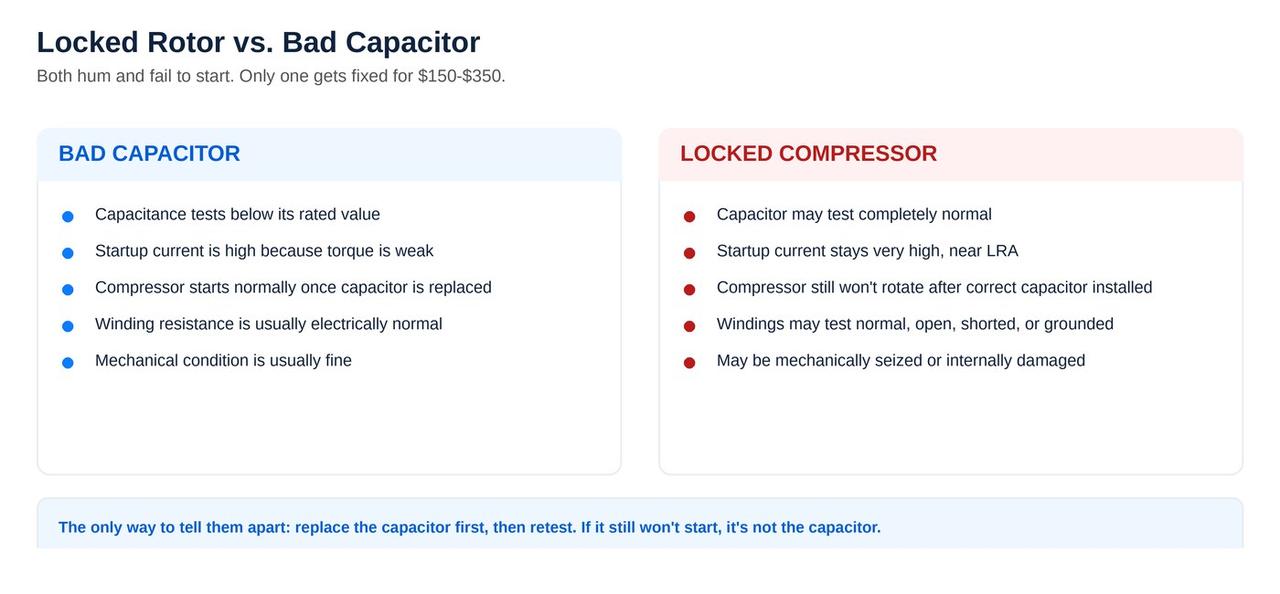
| Clue | Bad capacitor | Locked compressor |
|---|---|---|
| Capacitance test | Below rating or failed | May test normal |
| Startup current | May be high because startup torque is weak | Often remains very high near LRA |
| After correct capacitor replacement | Compressor starts normally | Compressor may still fail to rotate |
| Winding condition | May be electrically normal | May be normal, open, shorted, or grounded |
| Mechanical condition | Usually normal | May be seized or internally damaged |
Can a Locked Compressor Be Repaired?
The sealed compressor itself is usually replaced rather than rebuilt in the field.
Replacement of the compressor may make sense when:
- The system is relatively young
- The compressor is covered by parts warranty
- The indoor and outdoor equipment are otherwise healthy
- The refrigerant circuit is not severely contaminated
- The system is properly matched
Full-system replacement may be the better option when:
- The equipment is old and out of warranty
- The compressor is mechanically locked or grounded
- Other major components are deteriorated
- The system has repeated major failures
- Repair cost is high compared with remaining value
- The equipment uses an older refrigerant
Suspect a Locked Compressor in Spring or The Woodlands?
AC Repair Expo Heating & Cooling Inc provides compressor startup testing and second-opinion diagnostics throughout Spring, The Woodlands, Tomball, Cypress, Conroe, Humble, Kingwood, and nearby North Houston.
Our licensed technicians test voltage, capacitors, contactors, startup amperage, compressor windings, insulation to ground, refrigerant pressures, condenser airflow, and complete system condition before recommending repair or replacement.
Texas HVAC License TACLB43277C- Startup amperage testing
- Run-capacitor diagnosis
- Winding and ground checks
- Voltage-drop testing
- Compressor second opinions
- Repair-versus-replacement options
Frequently Asked Questions
What does locked rotor mean on an AC compressor?
It means the compressor motor is receiving power but the rotor is not turning.
What does a locked compressor sound like?
It often produces a deep hum, followed by a click when the thermal overload opens.
Will a locked compressor trip the breaker?
It can. High startup current may trip the breaker before the internal overload opens.
Can a bad capacitor look like a locked rotor?
Yes. A weak capacitor can prevent startup and create high current, so it must be tested first.
Can a hard start kit fix a locked compressor?
It may help a hard-starting compressor, but not one that is fully seized, grounded, or severely damaged.
What is LRA?
LRA means locked rotor amps, the current associated with a motor that is energized but not rotating.
Why does the compressor try again every few minutes?
The internal thermal overload may reset after cooling and allow another startup attempt.
Can low voltage cause a locked-rotor symptom?
Yes. Low voltage can reduce starting torque and cause high startup current.
Can a compressor test electrically normal and still be locked?
Yes. Winding resistance may appear normal even when the compressor is mechanically seized.
Is a locked compressor always out of warranty?
No. Warranty depends on equipment age, registration, manufacturer terms, and installation history.
Should I replace the compressor or the whole AC?
The answer depends on age, warranty, refrigerant type, overall condition, repair cost, and remaining expected life.
When should I call an HVAC technician?
Call when the compressor hums without starting, trips the breaker, dims lights, clicks on overload, or becomes extremely hot.