Thermostat Not Working: Causes, Diagnosis & Repair
A thermostat may stop working because it has no battery power, lost 24-volt control power, a blown low-voltage fuse, an open condensate float switch, loose wiring, a missing C-wire, a failed transformer, a damaged control board, or an internal thermostat fault.
The display can be blank, the thermostat can appear normal but fail to start the AC, or it can send a cooling call that never reaches the outdoor unit. The exact symptom determines where testing should begin.
Texas HVAC License TACLB43277C. Serving Spring, The Woodlands, Tomball, Cypress, Conroe, Humble, Kingwood, and nearby North Houston.
What This Guide Covers
Common Signs the Thermostat Is Not Working
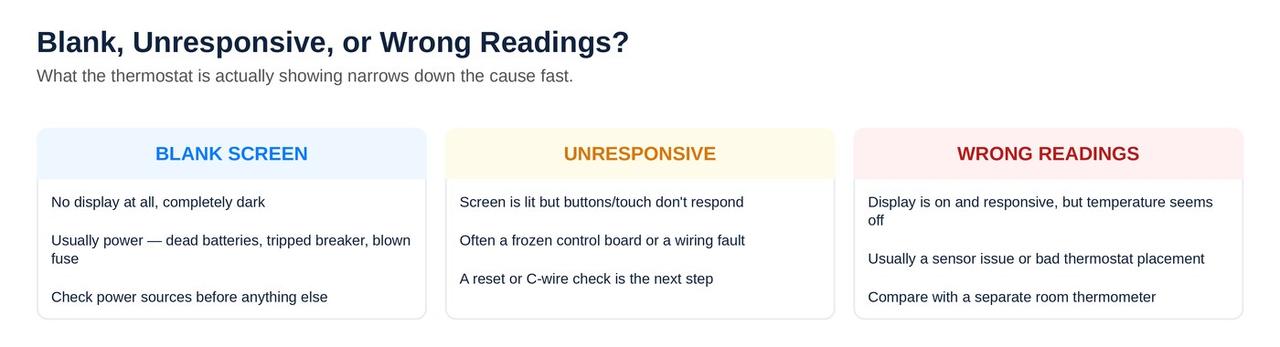
Blank Display
The thermostat may have dead batteries, lost control power, a tripped breaker, blown fuse, open float switch, or failed thermostat.
Display Works but AC Will Not Start
The thermostat may not be sending the cooling signal, or the signal may be interrupted before it reaches the outdoor unit.
Thermostat Clicks but Nothing Happens
The thermostat relay may close normally while a fuse, contactor, control board, safety switch, or equipment circuit prevents operation.
Temperature Reading Is Wrong
Sunlight, wall drafts, sensor failure, poor placement, or calibration problems may create an inaccurate reading.
System Starts and Stops Repeatedly
Loose wiring, unstable power, incorrect cycle settings, pressure or float switches, or thermostat faults may cause short cycling.
Thermostat Resets or Reboots
A weak transformer, missing C-wire, loose common connection, control-board issue, or power-stealing smart thermostat may be responsible.
Safe Homeowner Checks Before Calling
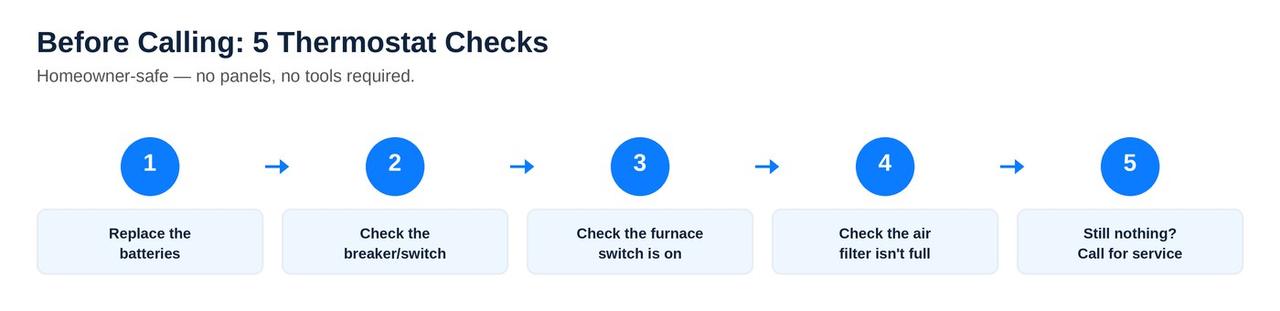
- Confirm the mode: Set the thermostat to COOL, not OFF, HEAT, or FAN-only.
- Lower the setpoint: Set it several degrees below the room temperature.
- Replace batteries: Use the correct fresh batteries if the thermostat has them.
- Check the breaker once: Reset it only if it is clearly tripped. Do not keep resetting it.
- Check the service switch: Make sure the furnace or air-handler switch was not turned off accidentally.
- Look for water: A full drain pan or clogged drain may open a float switch and interrupt cooling.
- Check schedules and holds: Smart schedules, vacation modes, and energy-saving programs can override manual changes.
- Wait through the delay: Many thermostats use a compressor-protection delay after a setting or power change.
15 Reasons a Thermostat Stops Working
1. Dead Thermostat Batteries
Battery-powered thermostats may show a blank screen or lose programming when the batteries fail.
2. Tripped HVAC Breaker
A tripped breaker can remove power from the furnace, air handler, transformer, control board, or outdoor unit.
3. Furnace or Air-Handler Switch Is Off
A nearby service switch can be turned off accidentally during cleaning, attic work, or maintenance.
4. Open Condensate Float Switch
A clogged drain or full pan may interrupt the cooling signal to prevent water damage.
5. Blown Low-Voltage Fuse
A shorted wire, contactor coil, thermostat, or installation mistake may open the control-board fuse.
6. Loose Thermostat Wire
A loose R, C, Y, G, W, or accessory wire can interrupt power or equipment commands.
7. Missing or Unstable C-Wire
Many smart thermostats need a reliable common connection for continuous power.
8. Failed 24-Volt Transformer
The transformer may fail from age, overheating, a short circuit, or excessive control load.
9. Failed Thermostat Relay or Electronics
The display may work while the thermostat fails to send a stable cooling, fan, or heating command.
10. Control-Board Failure
The furnace or air-handler board may fail to process or pass the thermostat signal.
11. Shorted Low-Voltage Wiring
Pinched, damaged, or rubbed thermostat wire can blow fuses or create intermittent operation.
12. Contactor-Coil or Outdoor Wiring Fault
A shorted contactor coil or outdoor control wire may pull down the 24-volt circuit.
13. Incorrect Programming or Schedule
A hold, geofence, eco mode, recovery setting, or schedule may override the expected setpoint.
14. Poor Thermostat Location
Sunlight, supply air, wall cavities, kitchens, and exterior walls can distort temperature readings.
15. Communicating-System Fault
Proprietary communicating thermostats may stop working because of network, equipment-address, software, or control faults.
Why Is the Thermostat Screen Blank?
A blank screen usually points to a power problem, not a temperature-sensing problem.
| Possible cause | Typical clue | Next diagnostic step |
|---|---|---|
| Dead batteries | Battery-powered thermostat loses display | Install correct fresh batteries |
| Open float switch | Water in pan or clogged drain | Correct drainage problem and test safety circuit |
| Blown low-voltage fuse | No 24-volt power; fuse open on board | Find the short before replacing the fuse |
| Failed transformer | Line voltage present but no low-voltage output | Test transformer and connected control load |
| Loose R or C wire | Display flickers, resets, or responds when base is moved | Inspect and secure connections |
| Failed thermostat | Correct power reaches thermostat but display remains blank | Confirm compatibility and replace if necessary |
Thermostat Is On, but the AC Will Not Start
If the display works, the next question is whether the thermostat is sending the cooling call.
- Thermostat may not connect R to Y during a cooling call.
- The Y signal may be interrupted by a float or pressure switch.
- The furnace or air-handler board may not pass the signal.
- The outdoor contactor may not receive 24 volts.
- The contactor coil may be open or shorted.
- The outdoor unit may have a separate high-voltage or compressor problem.
Follow the Signal
Professional diagnosis follows the cooling command from the thermostat to the indoor control, safety circuits, outdoor wiring, contactor, and equipment.
How the 24-Volt Thermostat Circuit Works
A transformer typically steps line voltage down to approximately 24 volts for the thermostat and control circuit.
| Terminal | Common function |
|---|---|
| R or Rc/Rh | 24-volt power from the transformer |
| C | Common return path for continuous thermostat power |
| Y or Y1/Y2 | Cooling or compressor-stage command |
| G | Indoor blower command on many conventional systems |
| W or W1/W2 | Heating-stage command |
| O/B | Heat-pump reversing-valve command |
Thermostat Problem vs. HVAC Equipment Problem
| Clue | More likely thermostat/control issue | More likely equipment issue |
|---|---|---|
| Display | Blank, resetting, inaccurate, or unresponsive | Display and commands appear normal |
| Cooling call | No stable Y signal from thermostat | Y signal reaches equipment but AC does not operate |
| Blower | G signal absent or unstable | G signal present but blower has electrical or motor fault |
| Outdoor unit | Contactor never receives control voltage | Contactor receives voltage but high-voltage components fail |
| Short cycling | Thermostat signal drops out | Safety switch or compressor overload opens while signal remains |
Thermostat Not Working vs. Not Reaching Set Temperature
These are different problems:
- Thermostat not working: The display, power, command, wiring, or internal controls are failing.
- Thermostat not reaching set temperature: The thermostat may be working correctly while the AC has airflow, refrigerant, sizing, duct, heat-load, or compressor problems.
Can a Condensate Drain Problem Shut Off the Thermostat?
Yes. Many systems use a float switch to stop cooling when the drain backs up.
Depending on how the safety is wired, the thermostat may:
- Remain powered but stop sending cooling
- Lose power and show a blank screen
- Display normally while the outdoor unit remains off
- Cycle intermittently as water moves in the drain or pan
Smart Thermostat Problems
Smart thermostats add power, network, scheduling, sensor, and software requirements.
C-Wire or Power Problem
The thermostat may reboot, disconnect, or fail to maintain a reliable equipment call.
Incorrect Equipment Setup
Wrong staging, heat-pump, fan-control, or reversing-valve settings can cause poor operation.
Schedule or Eco Override
Geofencing, learning schedules, demand-response events, or energy modes may change the setpoint.
Remote Sensor Problem
A remote room sensor may control the average temperature or create unexpected equipment calls.
Wi-Fi or App Issue
The app may appear offline while local thermostat control still works.
Compatibility Problem
Communicating, variable-capacity, millivolt, or proprietary systems may require specific controls.
How a Technician Diagnoses a Thermostat That Is Not Working
- Confirm thermostat mode, setpoint, schedule, and equipment configuration.
- Inspect batteries, base, terminals, and visible wiring.
- Verify line voltage to the furnace or air handler.
- Measure transformer primary and secondary voltage.
- Check the low-voltage fuse and find any short before replacement.
- Measure R-to-C power at the control board and thermostat.
- Verify Y, G, W, and O/B outputs during the proper calls.
- Inspect float switches, pressure switches, and interlocks.
- Check control-board inputs and outputs.
- Trace outdoor wiring to the contactor and safety circuit.
- Verify thermostat compatibility, staging, and smart-control settings.
- Test complete heating, cooling, and fan operation after repair.
Do Not Replace the Thermostat First and Diagnose Later
A new thermostat will not repair a failed transformer, shorted wire, open float switch, damaged control board, contactor fault, or outdoor-unit problem.
Common Repairs
- Replace thermostat batteries
- Correct programming and equipment settings
- Repair loose or damaged low-voltage wiring
- Add or repair a C-wire when appropriate
- Clear the condensate drain and reset the float switch
- Replace a failed transformer after correcting the cause
- Replace a blown fuse after locating the short
- Repair or replace a control board
- Repair outdoor contactor or control wiring
- Replace an incompatible or internally failed thermostat
Repair or Replace the Thermostat?
Thermostat replacement may make sense when the control is internally failed, incompatible, physically damaged, obsolete, or cannot support the equipment properly.
Repair is usually more appropriate when the cause is external:
- Dead batteries
- Loose wiring
- Open float switch
- Blown fuse
- Failed transformer
- Control-board or contactor problem
- Incorrect setup or schedule
Thermostat Not Working in Spring or The Woodlands?
AC Repair Expo Heating & Cooling Inc provides thermostat, 24-volt control, float-switch, transformer, wiring, control-board, contactor, and complete HVAC diagnostics throughout Spring, The Woodlands, Tomball, Cypress, Conroe, Humble, Kingwood, and nearby North Houston.
- Thermostat power and output testing
- 24-volt transformer diagnosis
- Fuse and low-voltage short testing
- Float-switch and drain diagnosis
- Control-board and contactor checks
- Smart thermostat setup and replacement
Frequently Asked Questions
Why is my thermostat screen blank?
Dead batteries, lost 24-volt power, a tripped breaker, open float switch, blown fuse, failed transformer, loose wire, or failed thermostat may cause a blank screen.
Why does the thermostat work but the AC does not start?
The thermostat may not be sending a Y signal, or the signal may be interrupted by wiring, safety switches, the control board, outdoor wiring, or the contactor.
Can a clogged drain make the thermostat stop working?
Yes. An open condensate float switch may interrupt cooling or remove thermostat power, depending on how it is wired.
Can a blown fuse make the thermostat blank?
Yes. A blown low-voltage fuse can remove control power from the thermostat and HVAC controls.
Why does my thermostat keep rebooting?
A weak or missing C-wire, unstable transformer voltage, loose common connection, control-board fault, or smart-thermostat power issue may cause reboots.
Can thermostat batteries stop the AC?
Yes, on thermostats that depend on batteries for control or display power.
What does the C-wire do?
The C-wire provides the common return path that many electronic and smart thermostats use for continuous power.
Can I replace a thermostat myself?
Simple conventional systems may appear straightforward, but incorrect wiring can blow fuses, damage transformers, misconfigure heat pumps, or create equipment problems.
Why does my thermostat click but nothing happens?
The thermostat relay may be working while a fuse, control board, safety switch, contactor, high-voltage circuit, or equipment component prevents operation.
Can a thermostat cause short cycling?
Yes. Loose wiring, poor placement, unstable power, incorrect cycle settings, or an internal relay fault may cause repeated starts and stops.
Does a blank thermostat always mean it is bad?
No. Power, safety-switch, fuse, transformer, breaker, wiring, and control-board problems are common causes.
When should I call an HVAC technician?
Call when the display stays blank after battery replacement, the fuse blows again, the breaker trips, water is present, or the thermostat sends unstable or incorrect equipment commands.