AC Compressor Won't Turn On?
If the outdoor fan runs but the compressor does not start, or the entire outside unit remains silent, the system needs electrical and mechanical diagnosis. The cause may be a failed capacitor, burned contactor, tripped breaker, open safety switch, damaged wiring, overheated compressor, locked rotor, or failed compressor winding.
This guide explains common symptoms, safe homeowner checks, proper technician testing, and when compressor repair or full AC replacement may be the better decision.
Licensed Texas HVAC contractor TACLB43277C. Serving Spring, The Woodlands, Tomball, Cypress, Conroe, Humble, Kingwood, and nearby North Houston communities.
What This Guide Covers
What the AC Compressor Does
The compressor circulates refrigerant between the indoor evaporator coil and outdoor condenser coil. It raises refrigerant pressure and temperature so the outdoor coil can reject heat removed from the home.
When the compressor does not start, the indoor blower may still run and the outdoor fan may sometimes operate, but the system cannot provide normal cooling.
- The air may feel room temperature.
- The outdoor fan may run without a deeper compressor sound.
- The thermostat may continue calling for cooling.
- The system may hum, click, or cycle repeatedly.
- The breaker may trip during startup.
Texas Technician Tip
Extreme outdoor heat increases compressor startup and operating stress. A marginal capacitor, loose terminal, weak contactor, or aging compressor may fail first during the hottest part of the day.
Safe Checks Before Calling for Service
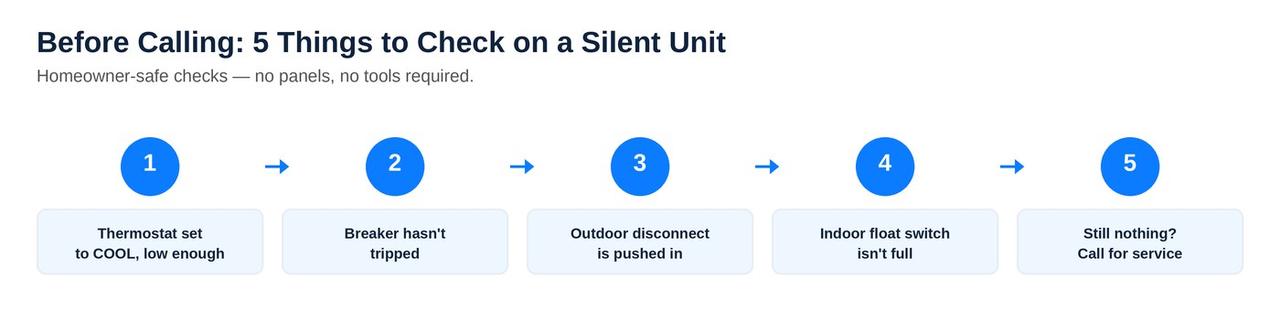
- Check the thermostat: Confirm it is set to COOL and below room temperature.
- Check the indoor blower: Note whether air is moving through the vents.
- Look at the outside unit: Observe whether the fan is spinning and listen for compressor sound.
- Check the breaker once: A tripped breaker may indicate a serious electrical or mechanical problem.
- Look for water issues: A float switch may stop cooling if the drain pan is full.
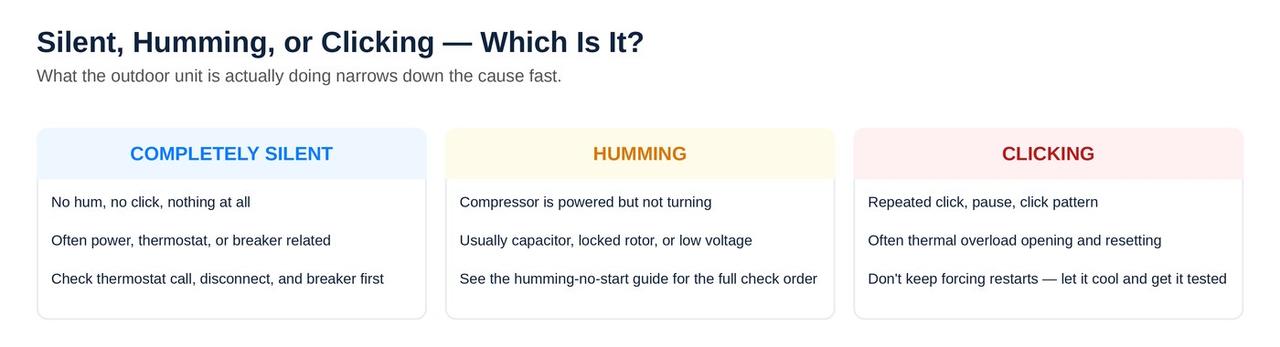
- Listen for startup attempts: Clicking, humming, buzzing, or repeated cycling are useful clues.
10 Common Reasons an AC Compressor Will Not Turn On
1. Weak or Failed Run Capacitor
The capacitor helps the compressor start and run. A weak compressor section of a dual-run capacitor can cause humming, delayed startup, repeated clicking, high startup current, or failure to start.
- Outdoor unit hums
- Compressor tries to start, then stops
- Breaker trips during startup
- Problem is worse in afternoon heat
- Capacitor tests below its rated microfarads
2. Burned or Failed Contactor
The contactor delivers high voltage to the compressor and fan. Burned contacts, a failed coil, damaged terminals, or low-voltage control problems can prevent the compressor from receiving power.
- No click at the outdoor unit
- Contactor buzzes or chatters
- Visible pitting or burned terminals
- Outdoor unit operates intermittently
- Voltage is present on one side but not the other
3. Tripped Breaker or Disconnect Problem
A tripped breaker, failed disconnect fuse, loose terminal, overheated disconnect, or voltage loss can stop the compressor.
- Outdoor unit is silent
- Indoor blower still runs
- Breaker trips when cooling starts
- Disconnect shows discoloration
- Failure occurred after a power surge
4. Compressor Thermal Overload
Compressors contain internal overload protection. If the compressor becomes too hot or draws excessive current, it may shut off until it cools.
- Compressor works when cool
- Stops during peak afternoon heat
- Restarts after a long delay
- Outdoor fan may continue running
- Compressor shell is extremely hot
5. Locked Rotor or Hard-Starting Compressor
A mechanically tight or locked compressor may draw very high current without starting. This can cause loud humming, dimming lights, breaker trips, or rapid overload cycling.
- Deep humming sound
- Compressor does not transition into normal running sound
- High locked-rotor amperage
- Breaker trips quickly
- Compressor starts only occasionally
6. Open Safety or Control Circuit
Float switches, pressure switches, low-voltage fuses, control boards, thermostat wiring, communicating controls, and condensate safety devices can interrupt the cooling signal.
- Contactor never receives 24 volts
- Drain pan is full
- Low-voltage fuse is open
- Control board shows a fault code
- Problem began after thermostat or wiring work
7. Loose or Burned Compressor Wiring
Compressor terminals and wiring can loosen, overheat, corrode, or burn. Severe terminal damage may require compressor replacement.
- Burning smell
- Melted wire insulation
- Discolored terminals
- Intermittent startup
- Arcing or electrical noise
8. Open, Shorted, or Grounded Compressor Windings
Internal motor windings can fail electrically. A grounded compressor may trip the breaker immediately and should not be energized repeatedly.
- Breaker trips on every call
- Winding resistance is abnormal
- Continuity exists from a terminal to ground
- Compressor remains silent despite correct voltage
- Electrical burning damage is present
9. Refrigerant or Pressure-Related Protection
Some systems use high-pressure and low-pressure switches. Dirty coils, failed outdoor fans, airflow problems, refrigerant restrictions, or severe charge problems can open a safety circuit.
- System stops after running
- Outdoor fan is not operating correctly
- Condenser coil is heavily restricted
- Pressure switch fault is present
- System restarts after pressure equalizes
10. Failed Compressor
A compressor may fail mechanically or electrically after years of heat, high current, poor airflow, refrigerant problems, contamination, repeated short cycling, or voltage stress.
- Correct power and capacitor are present
- Compressor will not start
- Windings are open, shorted, or grounded
- Mechanical lock is confirmed
- Terminal damage or internal failure is present
What If the Outdoor Fan Runs but the Compressor Does Not?
This symptom narrows the diagnosis but does not prove the compressor is failed. The fan and compressor share some components but also have separate circuits and windings.
Common causes include:
- Failed compressor side of the dual-run capacitor
- Open compressor thermal overload
- Burned compressor wire or terminal
- Failed compressor winding
- Locked rotor
- Control board or relay issue on certain systems
- Voltage imbalance or low voltage under load
What Different Compressor Symptoms May Mean
| Symptom | Possible causes | Best next step |
|---|---|---|
| Outdoor fan runs but compressor is silent | Open overload, wiring fault, failed winding, control issue, no voltage to compressor | Verify voltage, wiring, overload condition, and winding resistance. |
| Compressor hums but will not start | Weak capacitor, locked rotor, low voltage, mechanical failure | Turn system off and test startup circuit and amperage. |
| Compressor clicks every few minutes | Thermal overload, weak capacitor, high pressure, overheating | Check temperature, capacitor, current, condenser airflow, and refrigerant condition. |
| Breaker trips immediately | Grounded winding, shorted wiring, severe locked rotor, damaged contactor | Do not reset repeatedly; perform electrical isolation testing. |
| Compressor starts only when it is cooler outside | Weak capacitor, hard-starting compressor, voltage drop, thermal stress | Test under peak-load conditions. |
| Entire outdoor unit is silent | Breaker, disconnect, contactor, float switch, thermostat, control fault | Check power and low-voltage control path. |
| Compressor starts, then stops quickly | Overload, pressure fault, low voltage, refrigerant issue, internal failure | Measure current, voltage, pressure, and temperature during operation. |
How a Technician Tests an AC Compressor
- Confirm the thermostat is calling for cooling
- Verify line voltage at the disconnect and contactor
- Check voltage on the load side of the contactor
- Test the dual-run capacitor against its rating
- Inspect compressor wiring and terminals
- Measure compressor winding resistance
- Check for a short to ground
- Measure startup and running amperage
- Check voltage drop during startup
- Determine whether the internal overload is open
- Inspect condenser fan operation and coil condition
- Check refrigerant pressures and temperatures
- Evaluate whether a hard-start device is appropriate
- Confirm full system operation after repair
Diagnosis Before Replacement
A compressor should not be condemned based on sound alone. Proper testing should separate capacitor failure, voltage problems, open safety controls, overheated overloads, wiring damage, and true internal compressor failure.
Can a Hard Start Kit Fix a Compressor That Will Not Start?
A properly selected hard-start kit may help certain compressors that struggle during startup because of high starting torque requirements or voltage drop. It does not repair grounded windings, burned terminals, severe mechanical damage, or a fully locked compressor.
- The run capacitor must still be tested.
- Supply voltage must be verified.
- Compressor winding condition must be checked.
- Startup amperage should be measured.
- The kit must be correctly sized and approved for the application.
Why Compressors Overheat in Texas
- Dirty condenser coils
- Failed or slow condenser fan motors
- Weak capacitors
- Low supply voltage
- Loose or burned electrical connections
- Low refrigerant returning insufficient cooling to the compressor
- Refrigerant overcharge or restricted heat rejection
- Short cycling
- High compression ratio
- Extreme ambient temperature and long run times
See why an outdoor fan failure can place the compressor at risk.
Repair the Compressor Circuit or Replace the AC?
If the problem is a capacitor, contactor, wire, fuse, safety switch, or control issue, the repair may be straightforward. Compressor replacement is a much larger decision.
Replacement becomes more relevant when:
- The compressor is grounded, shorted, or mechanically locked
- The compressor terminals are severely damaged
- The system has a contaminated refrigerant circuit
- The equipment is near or beyond expected service life
- The system uses an older refrigerant and needs a major repair
- Other major components are also deteriorated
- The compressor is out of warranty
- Repair cost is high compared with the remaining equipment value
AC Compressor Won't Turn On in Spring or The Woodlands?
AC Repair Expo Heating & Cooling Inc provides compressor and no-cooling diagnostics throughout Spring, The Woodlands, Tomball, Cypress, Conroe, Humble, Kingwood, and nearby North Houston communities.
Our licensed technicians test capacitors, contactors, breakers, disconnects, wiring, compressor windings, startup amperage, refrigerant pressures, condenser airflow, and complete system operation before recommending repair or replacement.
Texas HVAC License TACLB43277C- Capacitor and contactor testing
- Compressor winding checks
- Startup amperage evaluation
- Breaker and voltage diagnosis
- Refrigerant and airflow review
- Clear repair-versus-replacement options
Frequently Asked Questions
Why won't my AC compressor turn on?
Common causes include a failed capacitor, bad contactor, tripped breaker, open safety switch, wiring problem, thermal overload, locked rotor, or failed compressor winding.
Can the outdoor fan run if the compressor is bad?
Yes. The fan motor and compressor are separate components, so the fan may run even when the compressor does not start.
What does a bad AC compressor sound like?
A failing compressor may hum, buzz, click repeatedly, grind, or trip the breaker, but sound alone cannot confirm compressor failure.
Can a bad capacitor stop the compressor from starting?
Yes. A weak or failed compressor section of a dual-run capacitor can prevent startup or cause high starting current.
Why does my compressor start after it cools down?
The internal thermal overload may have opened because the compressor overheated or drew excessive current.
Can I reset the AC breaker if the compressor will not start?
You may check it once, but do not repeatedly reset a breaker that trips again. Repeated resets can worsen electrical damage.
Can a hard-start kit fix a locked compressor?
It may help certain hard-starting compressors, but it cannot repair grounded windings, severe mechanical damage, or a fully failed compressor.
How do technicians know whether a compressor is grounded?
They perform resistance and insulation tests from each compressor terminal to ground after isolating the compressor electrically.
Does a compressor failure always mean I need a new system?
No. The best decision depends on age, warranty, refrigerant type, overall condition, repair cost, and expected remaining life.
Can low refrigerant stop a compressor from running?
Some systems use low-pressure protection that can open the control circuit. Low refrigerant can also contribute to overheating and poor compressor cooling.
Why does the compressor hum and then click off?
This often indicates failed startup, high current, weak capacitance, low voltage, mechanical resistance, or thermal overload operation.
When should I call an HVAC technician?
Call when the compressor does not start, the outdoor unit hums, the breaker trips, the compressor cycles on overload, or you notice burning smells or damaged wiring.