AC Hard Start Kit Explained
An AC hard start kit gives the compressor a brief boost of starting torque. It can help certain compressors start faster and reduce the time they remain in high-current startup, but it is not a cure for every no-start condition.
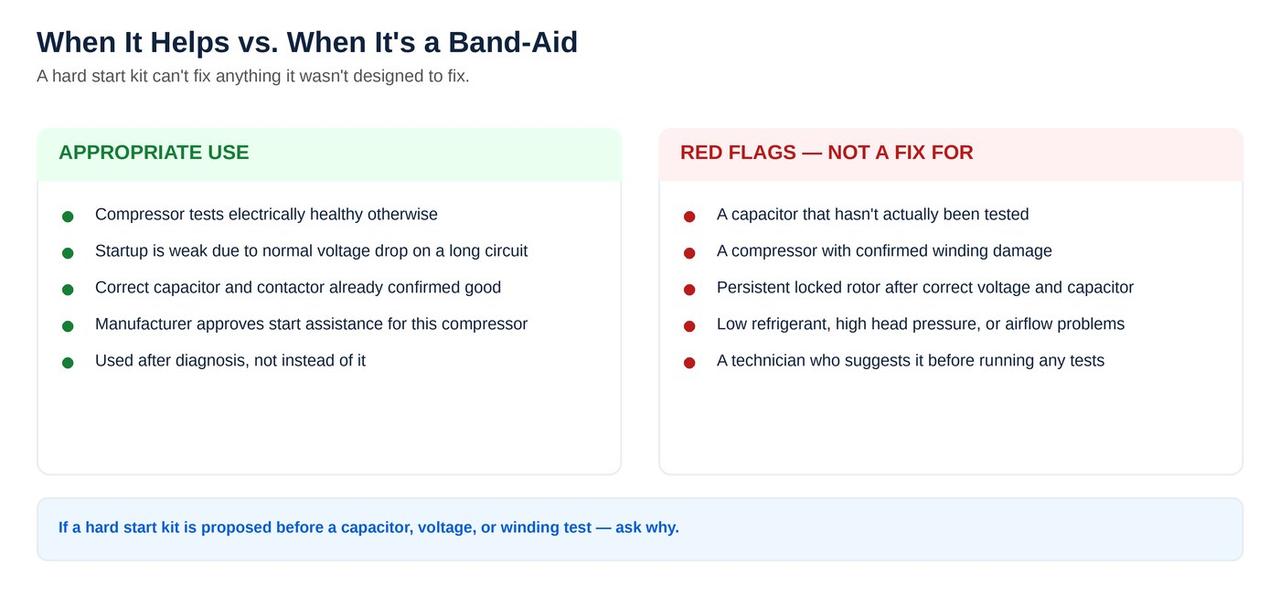
A hard start kit should be selected only after testing the run capacitor, voltage, contactor, compressor windings, startup amperage, and the actual cause of the startup problem.
Licensed Texas HVAC contractor TACLB43277C. Serving Spring, The Woodlands, Tomball, Cypress, Conroe, Humble, Kingwood, and nearby North Houston communities.
What This Guide Covers
What Is an AC Hard Start Kit?
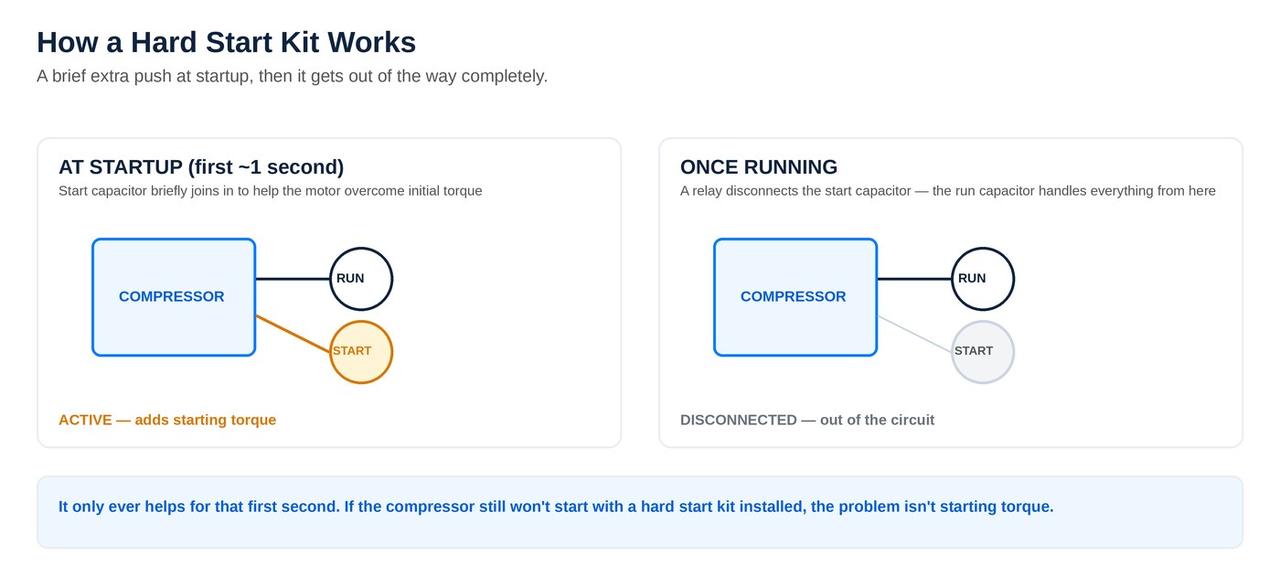
A hard start kit is an auxiliary starting device connected to the compressor circuit. Most residential kits include a start capacitor and a relay or electronic control that removes the start capacitor from the circuit after startup.
The goal is to increase starting torque and shorten the amount of time the compressor remains at locked-rotor or near-locked-rotor current.
Important Distinction
A hard start kit does not replace the normal run capacitor unless the product is specifically designed as a combined component. The run capacitor still must be correctly sized and functioning.
How Does a Hard Start Kit Work?
When the thermostat calls for cooling, the compressor must overcome internal pressure and mechanical resistance. The hard start kit temporarily adds capacitance to improve phase shift and starting torque.
- The contactor closes and sends power to the compressor.
- The start capacitor enters the circuit briefly.
- The compressor receives increased starting torque.
- The relay removes the start capacitor after startup.
- The compressor continues running on the normal run circuit.
If the start capacitor remains in the circuit too long, it can overheat or damage the compressor. Proper relay operation matters.
When a Hard Start Kit May Help
Compressor Starts Slowly
The compressor hesitates, hums briefly, or takes longer than normal to reach running speed, but the windings and mechanical condition still test acceptable.
High Startup Current
Measured startup current is high, and the compressor takes too long to transition into normal running amperage.
Voltage Drop During Startup
The electrical system experiences a temporary voltage drop when the compressor starts, but supply voltage and wiring remain within acceptable limits.
Long Refrigerant Lines
Certain installations with long line sets or difficult pressure conditions may benefit from added starting torque when allowed by the manufacturer.
Non-Bleed TXV Systems
Some systems restart against a larger pressure difference because the metering device does not equalize quickly.
Manufacturer-Recommended Application
Some equipment manufacturers specify or recommend a start-assist device for particular models or installation conditions.
When a Hard Start Kit Will Not Fix the Problem
- Grounded compressor windings
- Open or shorted windings
- Burned compressor terminals
- Severely locked mechanical components
- Incorrect or failing run capacitor
- Loose or burned wiring
- Low utility or supply voltage
- Failed contactor or excessive voltage drop
- Refrigerant overcharge or severe pressure problem
- Failed condenser fan motor
- Dirty condenser coil causing high pressure
- Control-board or thermostat failure
Installing a hard start kit without correcting these issues may delay proper repair and increase compressor stress.
Hard Start Kit vs. Run Capacitor
| Component | Main purpose | When active | Failure symptoms |
|---|---|---|---|
| Run capacitor | Supports compressor and fan motor operation | During startup and normal running | Humming, slow motor, overheating, no-start, high current |
| Start capacitor | Provides extra starting torque | Only during startup | Hard starting, long startup time, failed starts |
| Potential relay or electronic relay | Removes start capacitor from circuit | Immediately after compressor starts | Start capacitor stays engaged or does not engage |
Signs a Compressor May Be Hard Starting
- Deep humming before startup
- Compressor starts after several attempts
- Lights dim when the AC starts
- Breaker trips during startup
- Outdoor unit buzzes and then clicks off
- Compressor starts more easily in cooler weather
- Startup amperage remains high too long
- Internal overload opens repeatedly
How a Technician Decides Whether a Hard Start Kit Is Appropriate
- Verify the exact compressor model and manufacturer guidance
- Test the existing run capacitor
- Measure line voltage before and during startup
- Measure startup and running amperage
- Check compressor winding resistance
- Test for short to ground
- Inspect contactor condition and voltage drop
- Inspect wiring and compressor terminals
- Check condenser fan and coil condition
- Review refrigerant pressures and equalization
- Confirm the compressor is not in thermal overload
- Verify startup performance after installation
Correct Sizing Matters
An oversized, undersized, or incorrectly controlled start capacitor can create new problems. The device should match the compressor and application.
Risks of Installing the Wrong Hard Start Kit
- Excessive starting torque
- Start capacitor overheating
- Relay failure
- Start capacitor remaining in the circuit too long
- Compressor winding stress
- Nuisance breaker trips
- Masking a failing compressor
- Voiding manufacturer requirements in some applications
Universal kits can be useful in the correct application, but OEM requirements and compressor characteristics should guide the decision.
Can a Hard Start Kit Reduce Light Dimming?
It may reduce the duration of startup current if the compressor starts faster. It will not correct undersized wiring, weak electrical service, loose connections, low utility voltage, or a failing compressor.
If lights dim significantly, the electrical supply and compressor startup should both be evaluated.
Can a Hard Start Kit Extend Compressor Life?
In the right application, faster startup may reduce the time the compressor spends at very high starting current. However, a hard start kit does not correct overheating, poor airflow, dirty coils, refrigerant problems, short cycling, or voltage imbalance.
Long compressor life depends more on correct installation, airflow, refrigerant charge, electrical quality, and regular maintenance than on any single accessory.
Hard Start Kit, Compressor Repair, or AC Replacement?
A hard start kit may be reasonable when the compressor is electrically sound, the system is otherwise healthy, and testing shows a legitimate startup-assist need.
Replacement may be more appropriate when:
- The compressor is grounded or mechanically locked
- Startup problems return immediately
- The equipment is old and out of warranty
- The system has multiple major failures
- Repair cost is high compared with remaining value
- The compressor is already severely overheated or damaged
Need Compressor Startup Testing in Spring or The Woodlands?
AC Repair Expo Heating & Cooling Inc provides compressor startup diagnosis throughout Spring, The Woodlands, Tomball, Cypress, Conroe, Humble, Kingwood, and nearby North Houston.
Our licensed technicians test capacitors, contactors, voltage, startup current, compressor windings, refrigerant conditions, and complete system operation before recommending a hard start kit, repair, or replacement.
Texas HVAC License TACLB43277C- Run-capacitor testing
- Startup amperage checks
- Voltage-drop diagnosis
- Compressor winding testing
- Correct hard-start selection
- Repair-versus-replacement options
Frequently Asked Questions
What does an AC hard start kit do?
It briefly adds starting capacitance to increase compressor starting torque and shorten startup time.
Does every AC need a hard start kit?
No. Many systems start normally without one. It should be used only when the compressor or installation benefits from approved start assistance.
Can a hard start kit fix a bad compressor?
No. It cannot repair grounded windings, burned terminals, severe mechanical damage, or a fully failed compressor.
Is a hard start kit the same as a capacitor?
It usually includes a start capacitor, but it is different from the normal run capacitor that stays active during operation.
Can a hard start kit stop breaker trips?
It may help if long startup time is the cause, but breaker trips may also indicate a grounded compressor, shorted motor, wiring fault, or incorrect breaker.
Can a hard start kit reduce light dimming?
It may reduce startup duration, but it will not fix low voltage, undersized wiring, weak electrical service, or loose connections.
Can a hard start kit damage a compressor?
An incorrect or failed kit can create excessive electrical stress or leave the start capacitor engaged too long.
How do technicians know if a compressor needs one?
They measure voltage, startup current, run capacitance, winding condition, pressure behavior, and actual startup performance.
Will a hard start kit make an old compressor last longer?
It may improve startup in some cases, but it cannot reverse internal wear or correct overheating, refrigerant, airflow, or voltage problems.
What is a potential relay?
It is a control that removes the start capacitor from the circuit after the compressor reaches operating speed.
Can I install a universal hard start kit?
Only if it is appropriate for the compressor and installed correctly. Manufacturer requirements and electrical testing should guide selection.
When should I call an HVAC technician?
Call when the compressor hums, struggles to start, trips the breaker, dims lights, or repeatedly opens on overload.