AC Humming but Won't Start?
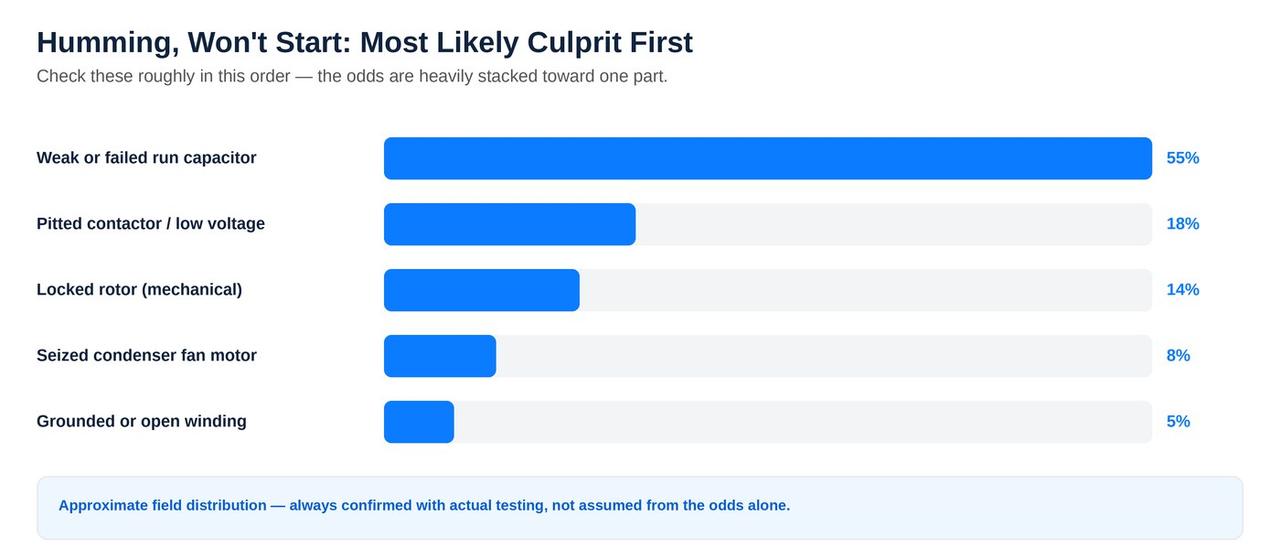
An AC that hums but will not start is usually receiving power, but one of its motors or electrical components cannot complete startup. Common causes include a weak capacitor, stalled condenser fan motor, locked compressor, low voltage, damaged contactor, loose wiring, or an open thermal overload.
This guide explains the most likely causes, safe homeowner checks, professional testing, and when a repair may prevent more serious compressor damage.
Licensed Texas HVAC contractor TACLB43277C. Serving Spring, The Woodlands, Tomball, Cypress, Conroe, Humble, Kingwood, and nearby North Houston communities.
What This Guide Covers
Why Does an AC Hum Without Starting?
Humming usually means electrical power is reaching a coil or motor, but the component is not moving or starting correctly. The sound may come from the contactor, compressor, fan motor, relay, or transformer.
The exact sound pattern matters:
- Steady hum with no movement: A motor may be stalled.
- Deep hum followed by a click: A compressor may be opening on overload.
- Rapid buzzing or chatter: Control voltage may be unstable.
- Hum with breaker trip: A motor or compressor may be drawing excessive current.
- Hum with outdoor fan stopped: The fan capacitor or motor may have failed.
Texas Technician Tip
Hot weather increases starting pressure and electrical load. Weak capacitors and aging motors often fail during the hottest afternoon hours, even if the system seemed normal earlier in the day.
Safe Checks Before Calling for Service
- Turn the thermostat off: Stop repeated startup attempts.
- Observe the outdoor fan: Note whether it spins, moves slowly, or stays still.
- Listen carefully: Identify whether the hum comes from the upper fan area or lower compressor area.
- Check the breaker once: Do not continue resetting it if it trips again.
- Check the drain pan: A float switch may interrupt cooling if water is present.
- Look for electrical warning signs: Burning odor, melted insulation, or smoke means leave the system off.
9 Common Causes of an AC Humming but Not Starting
1. Weak or Failed Capacitor
The capacitor provides the electrical phase shift needed for the compressor and fan motor to start and run. A weak capacitor can leave a motor energized but unable to begin turning.
- Outdoor unit hums but does not start
- Fan does not spin
- Compressor hums and clicks off
- Failure is worse during heat
- Capacitor is swollen or leaking
2. Locked or Hard-Starting Compressor
A compressor may receive power but fail to rotate. It may hum loudly, draw locked-rotor current, dim lights, and open the breaker or internal overload.
- Deep hum from lower cabinet
- Buzzing ends with a click
- Breaker trips
- Compressor retries every few minutes
- Startup amperage is very high
3. Condenser Fan Motor Stalled
A seized, overheated, or electrically failed fan motor may hum while the blade remains still. The compressor may continue running and overheat.
- Fan does not move
- Motor shell is very hot
- Fan starts and stops
- Grinding or squealing occurred first
- Compressor sound continues below the fan
4. Contactor or Relay Problem
A contactor or relay can hum if its coil is energized but contacts are damaged, contaminated, or receiving unstable control voltage.
- Buzzing comes from electrical compartment
- Rapid chattering
- Outdoor unit starts intermittently
- Contacts are burned or pitted
- Voltage drops across closed contacts
5. Low Voltage or Voltage Drop
Low supply voltage can prevent motors from developing enough starting torque. Loose terminals, long wire runs, utility problems, or overloaded circuits may contribute.
- Lights dim during startup
- Unit hums only during peak demand
- Contactor chatters
- Voltage drops under load
- Problem follows an outage
6. Loose or Burned Wiring
Loose compressor, motor, contactor, breaker, or disconnect connections can create voltage loss, heat, arcing, and humming.
- Burning odor
- Discolored terminals
- Intermittent operation
- Melted insulation
- Buzzing near wiring connections
7. Compressor or Motor Thermal Overload
An overheated motor may open its internal overload. It can remain silent while open, then hum again when it cools and retries.
- Unit works when cool
- Fails in afternoon heat
- Restarts after a long delay
- Motor or compressor is extremely hot
- Problem repeats more often over time
8. Mechanical Obstruction
Debris, a bent fan blade, damaged shroud, seized bearing, or other physical obstruction can prevent a motor from turning.
- Fan blade appears off-center
- Scraping or banging
- Debris is visible
- Motor hums but cannot turn
- Heavy vibration occurs during startup
9. Control Board or Safety-Circuit Fault
Some systems use control boards, pressure switches, float switches, communicating controls, and relays that can allow partial operation or repeated startup attempts.
- Fault code is present
- Contactor receives unstable signal
- Drain pan is full
- Low-voltage fuse opens
- Problem began after thermostat work
AC Humming but the Outdoor Fan Is Not Spinning
This often indicates a failed fan section of the dual-run capacitor, a stalled fan motor, blocked fan blade, damaged wiring, or loss of correct voltage to the fan motor.
AC Humming but the Compressor Is Not Starting
If the outdoor fan runs but the compressor only hums, common causes include a weak compressor capacitor, hard-starting compressor, low voltage, open thermal overload, damaged compressor wiring, or internal mechanical failure.
- Turn the thermostat off.
- Note whether the hum ends with a click.
- Do not reset a tripped breaker repeatedly.
- Have startup current, voltage, capacitance, and windings tested.
What Different Humming Symptoms May Mean
| Symptom | Possible causes | Best next step |
|---|---|---|
| Steady hum but fan does not move | Weak capacitor, failed fan motor, blocked blade | Turn cooling off and test fan circuit. |
| Deep hum followed by a click | Compressor failed startup, thermal overload, weak capacitor | Test compressor startup current and capacitor. |
| Humming with breaker trip | Locked motor, grounded compressor, shorted wiring | Do not reset repeatedly; perform isolation testing. |
| Rapid hum or chatter | Low control voltage, failing contactor coil, loose wiring | Check the 24-volt control circuit. |
| Hum only in extreme heat | Weak capacitor, overheating motor, voltage drop, hard-starting compressor | Test under peak-load conditions. |
| Indoor unit hums but blower does not start | Blower capacitor, ECM module, motor, board, or obstruction | Turn system off and diagnose indoor blower circuit. |
| Humming with burning smell | Loose connection, overheated motor, damaged wiring | Leave system off and arrange immediate service. |
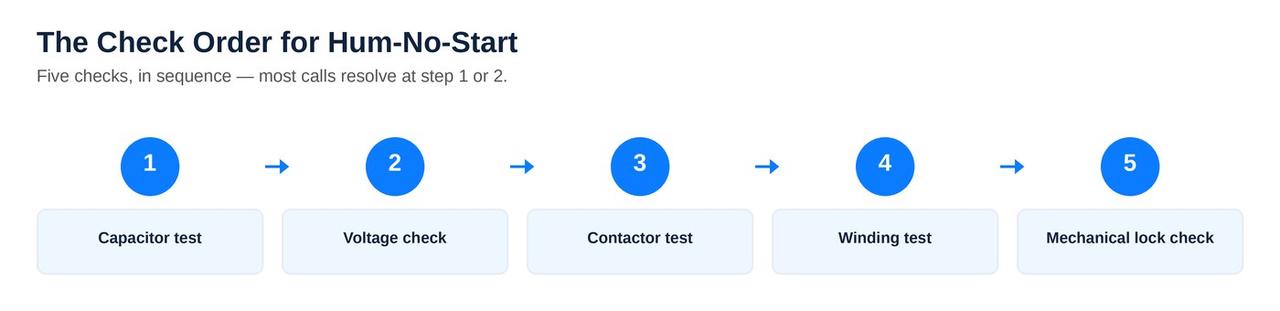
How a Technician Diagnoses an AC That Hums but Will Not Start
- Identify whether the sound comes from the compressor, fan motor, contactor, relay, or indoor blower
- Verify thermostat and control signals
- Measure supply and control voltage
- Inspect breaker, disconnect, wiring, and terminals
- Test capacitor value against its rating
- Measure fan-motor and compressor startup amperage
- Check compressor windings and insulation to ground
- Inspect the fan blade and motor bearings
- Evaluate contactor coil and voltage drop
- Check for thermal-overload operation
- Inspect condenser coil and airflow
- Verify refrigerant pressures and full system performance
Do Not Diagnose by Sound Alone
A weak capacitor, low voltage, locked compressor, bad motor, and loose connection can all produce similar humming. Testing is necessary before replacing parts.
Can a Hard Start Kit Help?
A correctly selected hard-start kit may help certain compressors that struggle to start under high load. It does not repair grounded windings, burned terminals, severe mechanical damage, or a failed fan motor.
- The run capacitor must be tested first.
- Supply voltage must be verified.
- Compressor winding condition must be checked.
- Startup amperage should be measured.
- The device must be properly sized for the system.
Does Humming Mean You Need a New AC?
Usually not. Many humming problems are caused by replaceable electrical components or motors.
Common repairable causes include:
- Capacitor
- Contactor
- Loose wiring
- Fan motor
- Relay
- Blower motor component
- Blocked fan blade
Replacement becomes more relevant if the compressor is grounded, mechanically locked, severely damaged, or if the system has multiple major failures and limited remaining value.
AC Humming but Won't Start in Spring or The Woodlands?
AC Repair Expo Heating & Cooling Inc provides startup and no-cooling diagnostics throughout Spring, The Woodlands, Tomball, Cypress, Conroe, Humble, Kingwood, and nearby North Houston communities.
Our licensed technicians test capacitors, contactors, fan motors, compressor startup, breakers, disconnects, wiring, control voltage, refrigerant performance, and complete system operation before recommending repair or replacement.
Texas HVAC License TACLB43277C- Capacitor and contactor testing
- Fan-motor and compressor checks
- Startup amperage evaluation
- Breaker and voltage diagnosis
- Wiring and terminal inspection
- Clear repair-versus-replacement options
Frequently Asked Questions
Why is my AC humming but not starting?
Common causes include a failed capacitor, stalled fan motor, locked compressor, bad contactor, low voltage, loose wiring, or thermal overload.
Should I turn off my AC if it is humming?
Yes, especially if the fan or compressor is not starting, the breaker trips, or the unit smells hot or electrical.
Can a bad capacitor make an AC hum?
Yes. A weak capacitor can leave a motor energized but unable to develop enough starting torque.
Why does the hum stop after a click?
The compressor or motor may have failed to start and opened its internal thermal overload.
Can the outdoor fan hum without spinning?
Yes. A failed capacitor, seized motor, blocked blade, or wiring problem can cause this symptom.
Why does my AC hum and trip the breaker?
This may indicate a locked motor, grounded compressor, shorted wiring, or severe startup-current problem.
Can low voltage cause humming?
Yes. Low voltage can reduce motor starting torque and cause contactors to chatter.
Can a hard-start kit fix the problem?
It may help certain hard-starting compressors, but only after voltage, capacitor, current, and winding condition are tested.
Does humming mean the compressor is bad?
Not necessarily. Capacitors, fan motors, contactors, wiring, and voltage problems can create similar sounds.
Why does the AC only hum during the hottest part of the day?
High heat increases pressure and electrical load, exposing weak capacitors, motors, voltage problems, and hard-starting compressors.
Can repeated humming damage the system?
Yes. Repeated failed starts create heat and electrical stress that can damage motors, wiring, terminals, and compressors.
When should I call an HVAC technician?
Call when the system hums without starting, trips the breaker, repeatedly clicks off, or produces burning odors or visible heat damage.