
AC Compressor Overheating: Causes, Symptoms & Repair
An AC compressor overheats when electrical, airflow, refrigerant, or mechanical conditions force it to operate above a safe temperature. Common causes include dirty condenser coils, failed condenser fans, low refrigerant, overcharge, high head pressure, low voltage, short cycling, floodback, and internal wear.
An overheating compressor may shut off on thermal overload, trip the breaker, produce a burning odor, cool poorly, or restart only after it has cooled.
Licensed Texas HVAC contractor TACLB43277C. Serving Spring, The Woodlands, Tomball, Cypress, Conroe, Humble, Kingwood, and nearby North Houston communities.
What This Guide Covers
What Does Compressor Overheating Mean?
The compressor contains an electric motor and mechanical pumping components inside a sealed shell. It depends on correct refrigerant flow, oil return, electrical supply, and condenser heat rejection to control temperature.
Overheating occurs when the compressor absorbs or creates more heat than the system can remove.
Hot Is Normal—Extreme Heat Is Not
Compressors normally run hot, especially in Texas summer weather. The concern is repeated overload trips, extreme shell temperature, high amperage, weak cooling, or signs of electrical and mechanical stress.
10 Symptoms of an Overheating AC Compressor
1. Outdoor Unit Shuts Off
The compressor may open its internal thermal overload while the indoor blower continues running.
2. Hum-Click-Retry Cycle
The compressor hums, clicks off, cools, and tries again.
3. Breaker Trips
High current or a developing electrical fault may trip the breaker.
4. Burning or Hot-Electrical Odor
Overheated windings, terminals, or wiring may produce an odor.
5. Weak Cooling
The compressor may lose capacity or shut off during the cycle.
6. Long Run Times
The system works harder and runs longer to satisfy the thermostat.
7. High Compressor Amperage
Electrical or refrigerant stress may increase current draw.
8. Very Hot Discharge Line
High compression ratio or poor cooling may elevate discharge temperature.
9. Compressor Starts Only After Cooling
The internal overload may reset after the shell temperature falls.
10. Loud or Abnormal Compressor Noise
Internal wear, floodback, or high pressure may change the sound.
14 Causes of AC Compressor Overheating
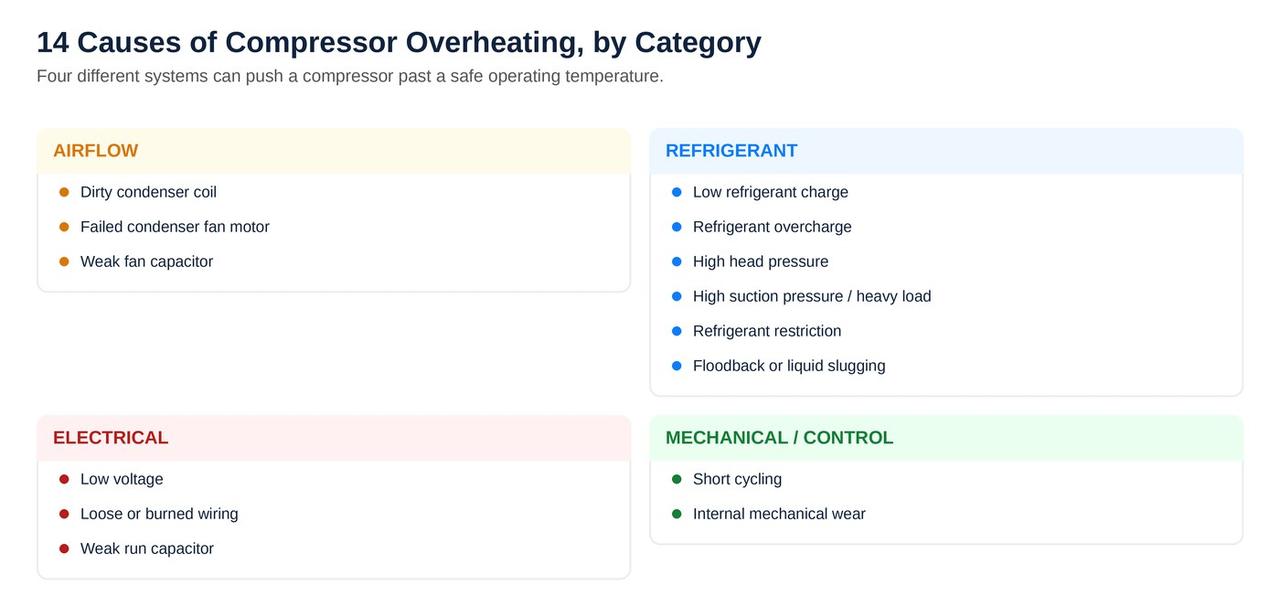
1. Dirty Condenser Coil
Restricted heat transfer raises head pressure, amperage, and compressor temperature.
2. Failed Condenser Fan Motor
Without proper airflow, the condenser cannot reject heat.
3. Weak Fan Capacitor
The fan may run slowly, start late, or stop during the hottest part of the day.
4. Low Refrigerant
Low charge can reduce compressor cooling and oil return while increasing superheat.
5. Refrigerant Overcharge
Too much refrigerant can raise head pressure, amperage, and floodback risk.
6. High Head Pressure
The compressor works against excessive discharge pressure.
7. High Suction Pressure and Heavy Load
High indoor load or overfeeding can increase compressor mass flow and amperage.
8. Low Voltage
Low voltage can increase current and reduce motor efficiency.
9. Loose or Burned Wiring
Voltage drop, arcing, and terminal heat add electrical stress.
10. Weak Run Capacitor
Incorrect phase shift can increase motor current and temperature.
11. Short Cycling
Repeated starts prevent pressure equalization and create heat.
12. Floodback or Liquid Slugging
Liquid refrigerant can dilute oil and damage internal components.
13. Refrigerant Restriction
Restrictions can raise compression ratio, reduce cooling, and limit oil return.
14. Internal Mechanical Wear
Worn bearings, valves, or internal parts increase friction and reduce efficiency.
Dirty Condenser Coil and Fan Problems
The condenser must remove heat from both the home and the compressor motor. A dirty coil or weak fan raises condensing temperature and pressure.
- Visible dirt or matted debris
- Fan not spinning or running slowly
- Motor stops after heating
- Fan capacitor below rating
- Pressure improves after cleaning or airflow correction
Low Refrigerant and Compressor Overheating
Low refrigerant can reduce suction-gas cooling and oil return. The compressor may run hot while the system cools poorly and runs longer.
- High superheat
- Low suction pressure
- Weak cooling
- Long run times
- Oil or leak evidence
- Very hot discharge line
Overcharge, High Head Pressure, and Compressor Heat
Overcharge and poor condenser airflow can both raise discharge pressure and compressor amperage.
Technicians compare condenser condition, fan performance, head pressure, subcooling, superheat, charge by weight, and amperage before removing refrigerant.
Low Voltage, Capacitors, and Electrical Heat
Electrical problems can create heat even when refrigerant readings appear normal.
- Low voltage under load
- Loose breaker or disconnect connection
- Pitted contactor contacts
- Weak run capacitor
- Burned compressor terminals
- Undersized or damaged wiring
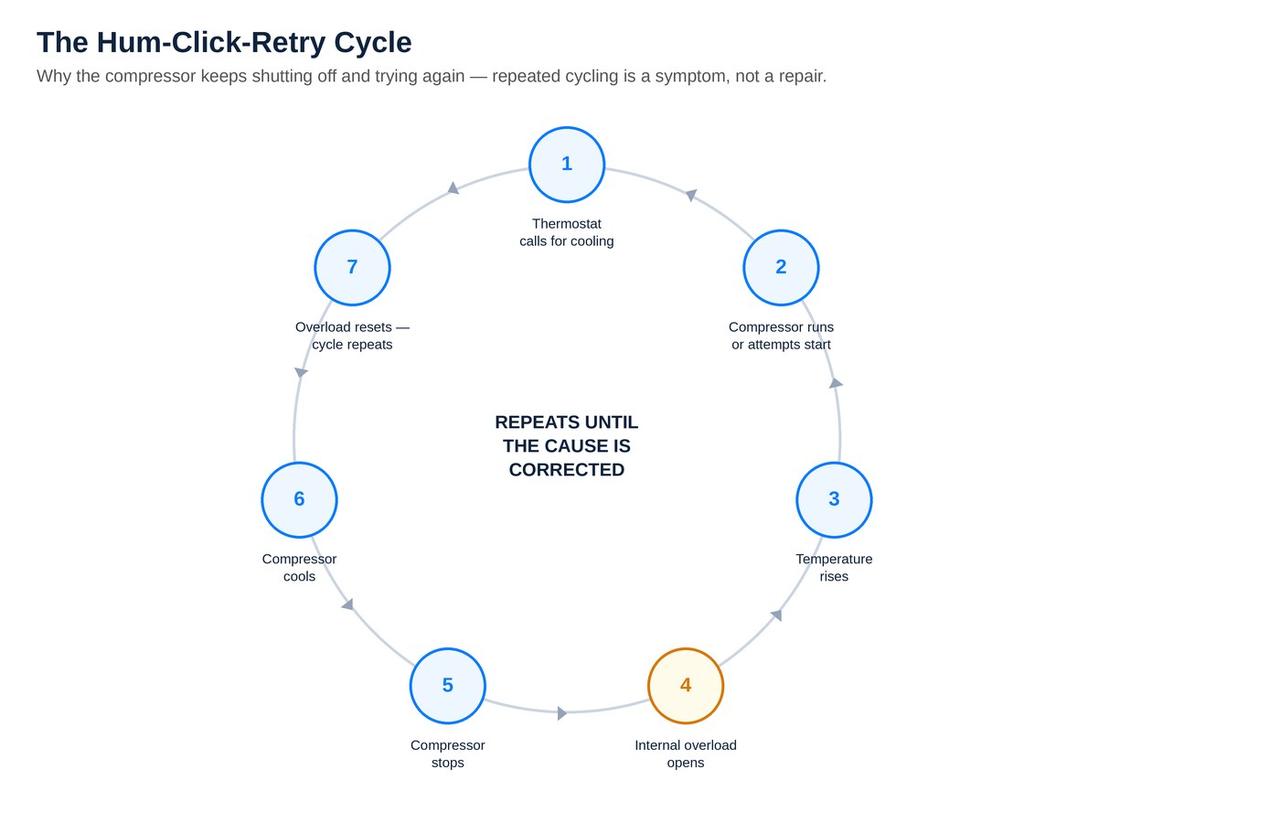
Why Does the Compressor Shut Off and Restart Later?
Most compressors have internal thermal-overload protection. When winding temperature and current become excessive, the overload opens.
- Thermostat calls for cooling
- Compressor runs or attempts to start
- Temperature rises
- Internal overload opens
- Compressor stops
- Compressor cools
- Overload resets and the cycle repeats
Compressor Overheating Diagnostic Comparisons
| Condition | Common clues |
|---|---|
| Overheating vs. locked rotor | Overheating may occur after running; locked rotor usually fails at startup with very high current |
| Overheating vs. weak capacitor | Weak capacitor changes phase shift and amperage; correct capacitance may restore operation |
| Overheating vs. dirty condenser | Dirty condenser shows restricted airflow and high head pressure that improve after cleaning |
| Overheating vs. overcharge | Overcharge often shows high subcooling and charge above specification |
| Overheating vs. internal failure | Internal failure may show abnormal winding, pumping, noise, or persistent overheating after external causes are corrected |
Compressor Overheating vs. Locked Rotor
| Clue | Overheating | Locked rotor |
|---|---|---|
| When failure occurs | Often after running | Usually at startup |
| Current | May be elevated while running | Often rises near locked-rotor amps |
| Sound | May run normally before clicking off | Deep hum without normal startup |
| After cooling | May restart and run temporarily | May retry but still fail to rotate |
How a Technician Diagnoses an Overheating Compressor
- Measure line voltage before and during operation
- Inspect breaker, disconnect, contactor, terminals, and wiring
- Test the run capacitor
- Measure compressor starting and running amperage
- Inspect condenser coil and fan operation
- Measure suction and head pressures
- Calculate superheat and subcooling
- Check discharge-line temperature
- Evaluate compression ratio
- Inspect for low charge, overcharge, or restriction
- Check winding resistance
- Test insulation to ground
- Inspect for floodback or liquid slugging
- Compare readings with manufacturer data
Find the Cause Before Replacing the Compressor
A new compressor can overheat again if the original airflow, electrical, refrigerant, or control problem is not corrected.
How Compressor Overheating Is Repaired
- Clean the condenser coil
- Repair or replace the condenser fan motor
- Replace a weak fan or compressor capacitor
- Repair burned wiring or contactor problems
- Correct low voltage or voltage drop
- Repair refrigerant leaks and restore proper charge
- Recover excess refrigerant
- Repair TXV or refrigerant restrictions
- Correct short cycling
- Correct blower and duct problems
When Does the Compressor Need Replacement?
Compressor replacement may be necessary when:
- Windings are grounded, open, or shorted
- The compressor remains mechanically locked
- Internal valves or pumping ability have failed
- Terminals are severely damaged
- The compressor repeatedly overheats after external causes are corrected
- Burnout contamination is severe
Full-system replacement may make more sense when the equipment is old, out of warranty, uses an older refrigerant, or needs several other major repairs.
Compressor Overheating in Spring or The Woodlands?
AC Repair Expo Heating & Cooling Inc provides compressor, refrigerant, airflow, and electrical diagnostics throughout Spring, The Woodlands, Tomball, Cypress, Conroe, Humble, Kingwood, and nearby North Houston.
Our licensed technicians test voltage, amperage, capacitors, condenser airflow, pressures, superheat, subcooling, windings, and complete system condition before recommending repair or replacement.
Texas HVAC License TACLB43277C- Compressor amperage testing
- Voltage and capacitor diagnosis
- Condenser airflow checks
- Refrigerant and pressure testing
- Winding and ground checks
- Repair-versus-replacement options
Frequently Asked Questions
Why is my AC compressor overheating?
Common causes include dirty condenser coils, failed fans, low refrigerant, overcharge, high pressure, low voltage, short cycling, and internal wear.
Is it normal for an AC compressor to be hot?
Compressors normally run hot, but repeated overload trips, extreme heat, burning odors, and weak cooling are not normal.
Why does the compressor shut off and restart later?
The internal thermal overload may open when temperature becomes excessive and reset after cooling.
Can a dirty condenser overheat the compressor?
Yes. Poor heat rejection raises head pressure, amperage, and compressor temperature.
Can low refrigerant overheat the compressor?
Yes. Low charge can reduce suction-gas cooling and oil return.
Can too much refrigerant overheat the compressor?
Yes. Overcharge can increase head pressure, amperage, and floodback risk.
Can a weak capacitor cause overheating?
Yes. Incorrect capacitance can increase current and motor temperature.
Can low voltage overheat the compressor?
Yes. Low voltage may increase current and reduce motor efficiency.
Can short cycling overheat the compressor?
Yes. Repeated starts create high current and may prevent pressure equalization.
Can an overheating compressor be repaired?
Often, if the cause is external. Internal mechanical or winding damage may require compressor replacement.
Should I keep running the AC?
No, not if it repeatedly clicks off, trips the breaker, smells hot, or the compressor becomes extremely hot.
When should I call an HVAC technician?
Call when the outdoor unit shuts off, cooling is weak, the breaker trips, or the compressor repeatedly opens on overload.