
AC Compressor Thermal Overload: Why It Trips and How It Resets
A compressor thermal overload is a protective device that opens when the compressor becomes too hot or draws too much current. It may reset automatically after the compressor cools, but repeated trips mean there is an underlying problem.
Common causes include dirty condenser coils, failed fans, weak capacitors, low voltage, refrigerant overcharge, low refrigerant, high head pressure, short cycling, locked rotor conditions, and internal compressor wear.
Texas HVAC License TACLB43277C.
What This Guide Covers
What Is a Compressor Thermal Overload?
The overload is designed to interrupt power to the compressor motor when winding temperature or current rises beyond a safe limit.
Many residential compressors use an internal overload located inside the sealed shell. Some systems may also use external protection or electronic controls.
The Overload Is a Safety Device
When it opens, the compressor is being protected from additional heat or current. Bypassing or defeating protection is unsafe.
How Long Does a Compressor Overload Take to Reset?
Reset time varies with compressor size, shell temperature, outdoor temperature, airflow, and the severity of the trip.
| Condition | Possible reset behavior |
|---|---|
| Light thermal trip | May reset after the compressor cools |
| Severe overheating | May require a much longer cooling period |
| Extreme Texas afternoon heat | Cooling can take longer because outdoor temperature remains high |
| Grounded, open, or locked compressor | May not return to normal operation even after reset |
Common Thermal Overload Symptoms
Outdoor Fan Runs but Compressor Stops
The fan may continue operating while the internal compressor overload is open.
Hum, Click, and Retry
The compressor attempts to start, overheats, opens the overload, and tries again later.
Cooling Returns Temporarily
The compressor may restart after cooling, then trip again under load.
Compressor Shell Extremely Hot
Excessive temperature is a strong overload clue.
No Continuity Through Common
A hot internal overload can temporarily make common-to-run and common-to-start appear open.
Weak or Intermittent Cooling
The home warms up each time the compressor drops out.
12 Causes of Compressor Thermal Overload Trips
1. Dirty Condenser Coil
Poor heat rejection raises pressure, amperage, and temperature.
2. Failed Condenser Fan
Without airflow, the compressor overheats quickly.
3. Weak Run Capacitor
Incorrect capacitance increases startup and running stress.
4. Low Voltage
Low voltage may reduce torque and increase current.
5. Loose or Burned Wiring
Voltage drop and resistance create additional heat.
6. High Head Pressure
The compressor works against excessive discharge pressure.
7. Refrigerant Overcharge
Too much refrigerant can raise pressure and amperage.
8. Low Refrigerant
Low charge can reduce compressor cooling and oil return.
9. Short Cycling
Repeated starts create heat and may occur before pressure equalizes.
10. Locked Rotor
The compressor draws very high startup current without rotating.
11. Refrigerant Restriction
High compression ratio and reduced cooling can overheat the motor.
12. Internal Mechanical Wear
Worn valves, bearings, or other parts increase heat and reduce efficiency.
Dirty Condenser Coil and Fan Failure
The condenser removes heat from the home and the compressor. If the coil is dirty or the fan fails, the compressor may trip on overload even though the electrical windings are still intact.
- Fan not spinning
- Fan running slowly
- Motor stopping after heating
- Coil packed with dirt or grass
- High head pressure
- High running amperage
Weak Capacitor and Failed Startup
A weak compressor capacitor may allow repeated failed starts. Current rises, the compressor heats, and the overload opens.
A correct capacitor may solve the problem if:
- Windings test normally
- No ground fault is present
- Voltage is correct
- The compressor starts and amperage normalizes
- Refrigerant pressures are acceptable
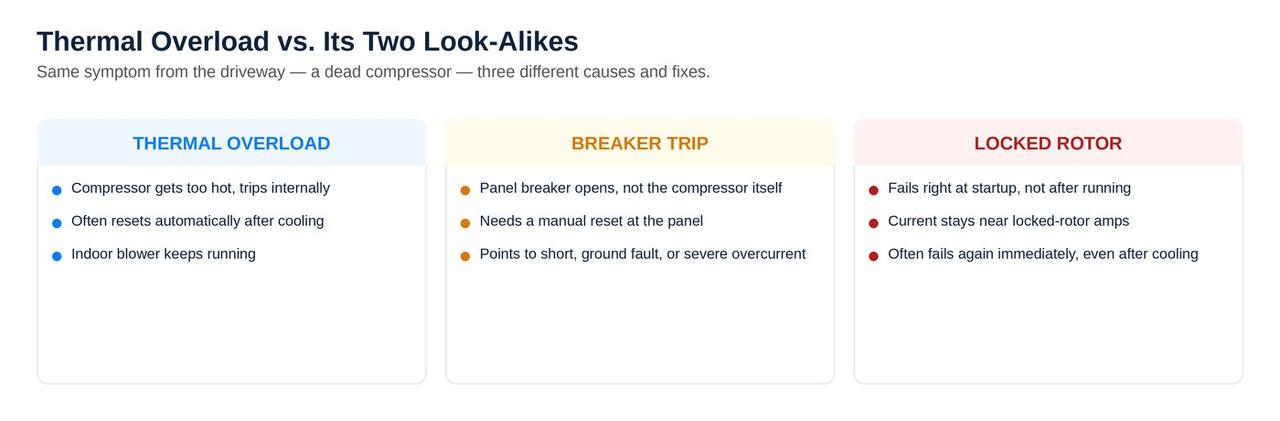
Thermal Overload Trip vs. Circuit Breaker Trip
| Clue | Thermal overload | Circuit breaker |
|---|---|---|
| What opens | Protection inside or near compressor | Electrical panel breaker |
| Reset behavior | Often automatic after cooling | Usually requires manual reset |
| Indoor blower | May continue running | Depends on circuit arrangement |
| Common causes | Heat, high current, failed startup | Short circuit, ground fault, locked rotor, severe overcurrent |
Thermal Overload vs. Locked Rotor
| Clue | Thermal overload | Locked rotor |
|---|---|---|
| When it occurs | May occur during startup or after running | Occurs at startup |
| Current | Can be high before trip | Often remains near locked-rotor amps |
| After cooling | May restart temporarily | Often fails again immediately |
| Winding resistance | May look open while hot | Can test normal even though rotor is mechanically stuck |
Read the locked rotor symptoms guide.
Thermal Overload vs. Open Winding
A hot internal overload can make a compressor appear to have open windings.
| Clue | Open overload | True open winding |
|---|---|---|
| Compressor shell | Usually very hot | May be hot or cool |
| After cooling | Continuity may return | Reading remains open |
| Common-to-run/start readings | May be open temporarily | Remain open |
| Repair | Correct cause of overheating | Compressor replacement usually required |
How a Technician Diagnoses Repeated Overload Trips
- Measure compressor shell temperature
- Verify supply voltage under load
- Inspect breaker, disconnect, contactor, and wiring
- Test the run capacitor
- Measure startup current and running amps
- Inspect condenser coil and fan operation
- Measure suction and head pressures
- Calculate superheat and subcooling
- Check discharge-line temperature
- Test winding resistance after cooling
- Test each terminal to ground
- Evaluate locked-rotor and pumping conditions
Cooling the Compressor Is Not the Repair
The system may restart after cooling, but the underlying electrical, airflow, refrigerant, or mechanical problem must still be corrected.
How Thermal Overload Problems Are Repaired
- Clean the condenser coil
- Repair or replace the condenser fan motor
- Replace a weak capacitor
- Repair burned wiring or contactor contacts
- Correct low voltage or excessive voltage drop
- Repair refrigerant leaks and restore proper charge
- Recover excess refrigerant
- Repair refrigerant restrictions
- Correct short cycling
- Replace a failed compressor when internal damage is confirmed
When Does the Compressor Need Replacement?
Replacement may be necessary when:
- The compressor is grounded
- Windings remain open after cooling
- The rotor remains mechanically locked
- Internal pumping has failed
- Terminals are severely burned
- Overload trips continue after external causes are corrected
Compressor Clicking Off in Spring or The Woodlands?
AC Repair Expo Heating & Cooling Inc provides compressor overload, electrical, refrigerant, and airflow diagnostics throughout Spring, The Woodlands, Tomball, Cypress, Conroe, Humble, Kingwood, and nearby North Houston.
- Capacitor and voltage testing
- Startup and running amp checks
- Condenser airflow diagnosis
- Pressure and refrigerant testing
- Winding and ground checks
- Second-opinion diagnostics
Frequently Asked Questions
What is a compressor thermal overload?
It is a protective device that opens when compressor temperature or current becomes excessive.
Does a compressor overload reset automatically?
Many internal overloads reset after the compressor cools, but reset time varies.
How long does it take to reset?
There is no universal time. Severe overheating and hot outdoor conditions can make cooling take much longer.
Why does my compressor start and stop repeatedly?
It may be overheating, failing to start, or operating under excessive electrical or refrigerant load.
Can a bad capacitor trip the overload?
Yes. A weak capacitor can cause high startup current and repeated failed starts.
Can a dirty condenser trip the overload?
Yes. Poor heat rejection raises compressor pressure, amperage, and temperature.
Can low refrigerant trip the overload?
Yes. Low charge can reduce compressor cooling and oil return.
Can overcharge trip the overload?
Yes. Overcharge can increase head pressure and running current.
Can the overload make windings look open?
Yes. A hot internal overload can temporarily interrupt common-to-run and common-to-start continuity.
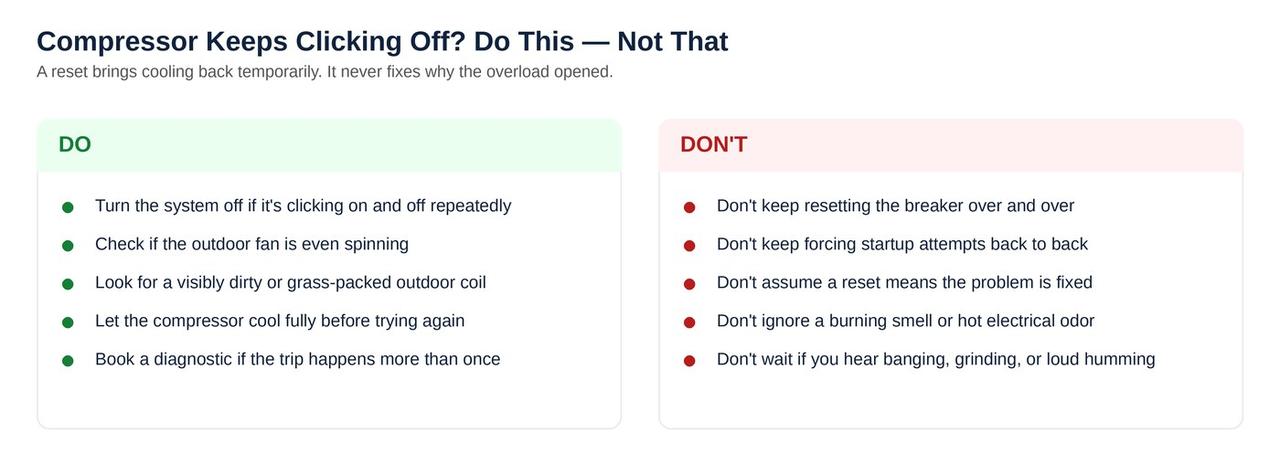
Should I keep resetting the breaker?
No. Repeated resets can worsen electrical or compressor damage.
Does an overload trip mean the compressor is bad?
Not always. Capacitors, fans, dirty coils, voltage, refrigerant, and controls can cause the trip.
When should I call for service?
Call when the compressor repeatedly clicks off, trips protection, smells hot, or cooling becomes intermittent.