
Grounded vs. Open AC Compressor Windings
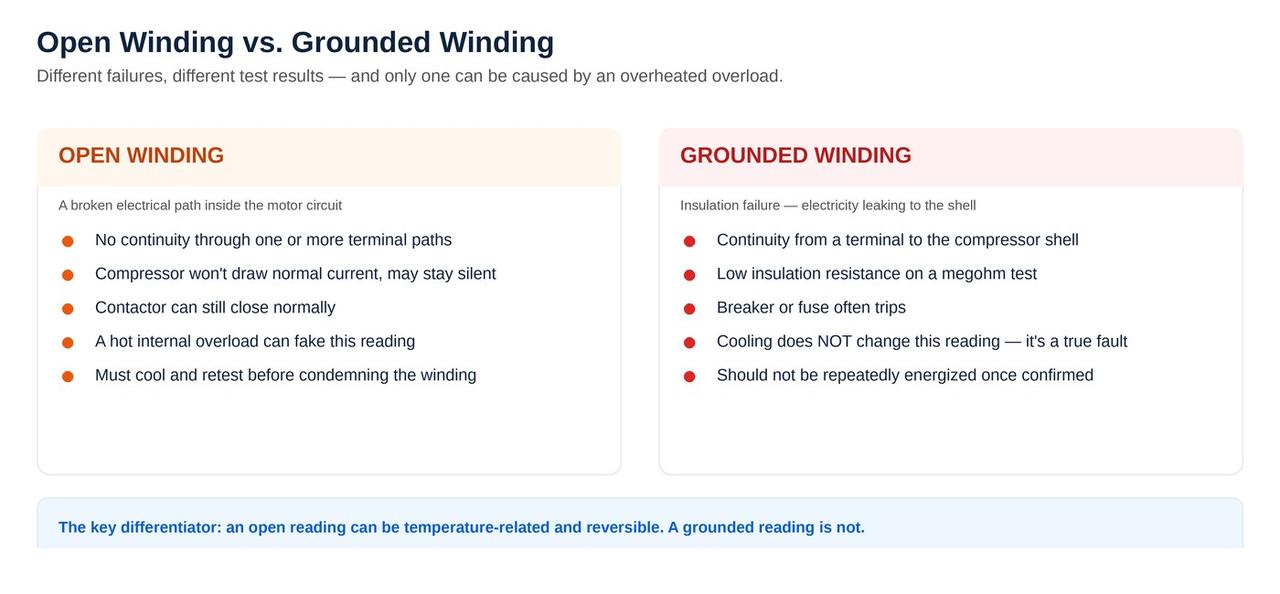
A grounded winding has an electrical path from the motor winding to the compressor shell. An open winding has a broken electrical path inside the motor circuit. Both conditions can prevent startup, but they produce different test results and symptoms.
A hot internal overload can also make a good winding appear open temporarily, which is why temperature and retesting matter.
Texas HVAC License TACLB43277C.
What This Guide Covers
Compressor Winding Basics
Most single-phase residential compressors have three terminals:
Common (C)
The shared connection point for the run and start windings.
Run (R)
The terminal connected to the lower-resistance run winding.
Start (S)
The terminal connected to the higher-resistance start winding.
| Measurement | Typical relationship |
|---|---|
| C–R | Usually the lowest resistance |
| C–S | Usually higher than C–R |
| R–S | Approximately equal to C–R plus C–S |
Model and Temperature Matter
Exact resistance values vary. The relationship between readings is often more useful than one universal ohm value.
What Is an Open Compressor Winding?
An open winding has a break in the internal electrical path.
- No continuity through one or more terminal combinations
- Compressor does not draw normal current
- Outdoor fan may run while compressor remains off
- Contactor may close normally
- No normal compressor startup sound
What Is a Grounded Compressor Winding?
A grounded winding occurs when winding insulation fails and electricity leaks to the compressor shell.
- Continuity from a terminal to the shell
- Low insulation resistance on a megohm test
- Breaker or fuse may trip
- Contactor may spark or chatter
- Burning odor or terminal damage may be present
What Is a Shorted Winding?
A shorted winding occurs when turns inside the winding lose insulation and electrically connect.
- Resistance may be lower than expected
- Winding relationships may be abnormal
- Running current may be high
- Motor may overheat quickly
- Breaker or overload may trip
A standard ohmmeter may not reveal every turn-to-turn short. Current, temperature, and insulation testing may also be needed.
How Technicians Test Compressor Windings
- Disconnect power at the breaker and disconnect.
- Verify zero voltage with a meter.
- Discharge the capacitor safely.
- Remove and label compressor wires.
- Inspect terminals for burning or damage.
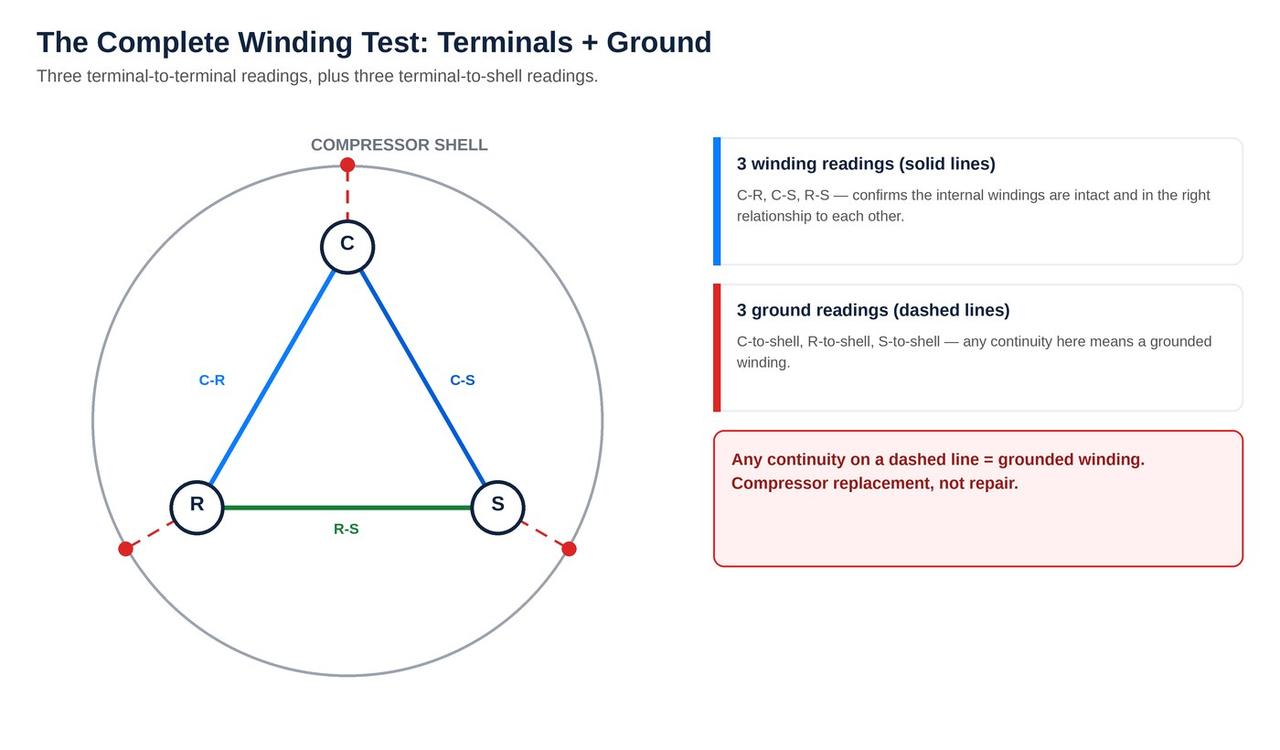
- Measure C–R, C–S, and R–S resistance.
- Test each terminal to the compressor shell.
- Use an insulation-resistance tester when appropriate.
- Allow a hot compressor to cool and retest.
- Compare results with model data and symptoms.
Ohmmeter vs. Insulation Resistance Testing
| Test | Best use | Limitation |
|---|---|---|
| Standard ohmmeter | Continuity and winding relationships | May miss insulation breakdown that appears under higher test voltage |
| Megohm or insulation tester | Winding insulation condition to ground | Results must be interpreted with temperature, moisture, and manufacturer guidance |
Internal Thermal Overload Can Mimic an Open Winding
When the compressor overheats, its internal overload may open the common circuit.
This may produce:
- No continuity from common to run
- No continuity from common to start
- Possible continuity from run to start
- Compressor shell extremely hot
- Normal readings after cooling
Retest After Cooling
Do not condemn an open winding until the internal overload condition has been considered.
Open vs. Grounded Winding Comparison
| Clue | Open winding | Grounded winding |
|---|---|---|
| Terminal-to-terminal continuity | Missing through one or more paths | May appear normal or abnormal |
| Terminal-to-shell test | No continuity expected | Continuity or low insulation resistance present |
| Breaker trip | Not always | Common |
| Internal overload effect | Can create temporary open readings | Does not create a true terminal-to-shell path |
| Typical repair | Compressor replacement if truly internal | Compressor replacement |
Grounded Winding vs. Locked Rotor
| Clue | Grounded winding | Locked rotor |
|---|---|---|
| Terminal-to-shell test | Fails | May pass |
| Startup current | May trip instantly | Often rises near LRA |
| Sound | May trip before sustained hum | Often deep hum without rotation |
| Mechanical condition | Electrical insulation failure | Rotor cannot begin turning |
Grounded Winding vs. Bad Capacitor
| Clue | Grounded winding | Bad capacitor |
|---|---|---|
| Terminal-to-shell test | Fails | Passes |
| Capacitance | May test normal | Below rating or failed |
| After capacitor replacement | Fault remains | Compressor may start normally |
| Breaker behavior | May trip quickly | May hum, overheat, or trip after failed startup |
Open Winding vs. Thermal Overload
| Clue | True open winding | Open thermal overload |
|---|---|---|
| Compressor temperature | May be normal or hot | Usually very hot |
| After cooling | Reading remains open | Continuity may return |
| Underlying cause | Broken internal conductor | Overheating, high current, or failed startup |
Can Burned Terminals Mimic Winding Failure?
Yes. A burned plug, loose wire, or damaged terminal can interrupt current even if the internal winding is intact.
- Inspect terminal pins carefully
- Check continuity directly at the compressor
- Look for carbon tracking or melted insulation
- Confirm whether the terminal itself is mechanically secure
Repair or Replace?
External repairs may solve the problem when the fault is a capacitor, contactor, wire, plug, or loose terminal connection.
Compressor replacement is generally required when:
- Winding is grounded
- Winding remains open after cooling
- Internal winding is shorted
- Terminal damage is severe
- Repeated overheating has caused internal failure
Full-system replacement may be a better investment when the equipment is old, out of warranty, uses an older refrigerant, or needs several major repairs.
Need Compressor Winding Testing in Spring or The Woodlands?
AC Repair Expo Heating & Cooling Inc provides compressor electrical and refrigerant diagnostics throughout Spring, The Woodlands, Tomball, Cypress, Conroe, Humble, Kingwood, and nearby North Houston.
- C–R, C–S, and R–S testing
- Ground and insulation checks
- Thermal overload diagnosis
- Startup amperage testing
- Terminal and wiring inspection
- Second-opinion diagnostics
Frequently Asked Questions
What is a grounded compressor winding?
It is a winding insulation failure that creates an electrical path from a compressor terminal to the metal shell.
What is an open compressor winding?
It is a broken electrical path inside one or more winding circuits.
How do you test compressor windings?
Technicians measure C–R, C–S, and R–S resistance, then test each terminal to the shell.
Can a hot compressor appear open?
Yes. The internal thermal overload may open until the compressor cools.
Can a grounded compressor be repaired?
The sealed compressor is usually replaced rather than repaired in the field.
Can a bad capacitor cause open winding readings?
No. A bad capacitor can prevent startup, but it does not create an internal open winding reading.
Can a locked rotor have normal winding resistance?
Yes. A mechanically locked compressor may still pass basic winding resistance tests.
What does continuity to the compressor shell mean?
It usually indicates a grounded winding or severe terminal contamination that must be investigated.
What does R–S equal?
R–S should be approximately the sum of C–R and C–S.
Can burned wiring look like an open compressor?
Yes. External wiring or terminal damage can interrupt current even when the internal winding is intact.
Should a grounded compressor be energized again?
No. Repeated energizing can trip protection and create additional electrical damage.
When should I get a second opinion?
Get one before approving compressor replacement if overload temperature, external wiring, and ground testing were not fully checked.